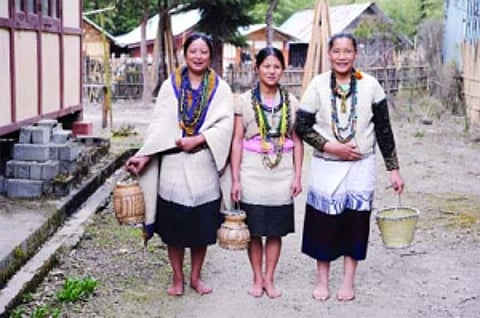

An ongoing exhibition at IGNCA presents traditional textiles and weaving techniques from the North East. It also shares interesting community myths and stories behind their designs. D Kaushik reports
Simphak are the traditional bark cloth blankets made by the Garo community in Meghalaya using material from local trees like phakram. Adi tribe is known to weave cotton pile blanket called gaduk. In Tirap district of Arunachal, the main tribes are the Nokteys who have no tradition of weaving. But their neighbours, the Wanchoos, carry their memories of head-hunting in their woven artefacts. The wives and daughters of the chieftains use a miniature loin-loom on which they weave lengtis (loin-cloths) for the men and shoulder bags. On a warp of coarse cotton like fibre, designs in vivid red, orange, yellow, outlined with black are woven in. Stylised human figures stand out while there are also geometrical patterns. These designs are also replicated in the beadwork of this tribe.
like these there are facts that you come across through an exhibition, Threads of Change, Textile cultures of North East India, at Indira Gandhi National Center for the Arts (IGNCA), in collaboration with National Institute of Design (NID).
As the title of the exhibition suggests the idea is to bring to light the changes in the traditional textiles of the North East. The spokesperson from NID said, “We are currently displaying findings from Assam, Arunachal Pradesh, Nagaland and Meghalaya, where data has been collected over the past three years. North East has been majorly unexplored and like other parts of the country, things are changing fast. Before the craft totally disappears we thought of documenting it so that the future generations, scholars and researchers would have some reference to find details about the weaving techniques and traditions of various tribal communities of the North East.” The exhibition has pictures revealing women at work. The Monpas and Sherdukpens of Kameng, the Mishmis and Khamtis of lohit, Naga tribes and even the Assamese in the plains, it is the women who weave unlike the rest of India, where men predominate the weaving profession. Many tribes have a taboo which prohibits weaving by a man who, it is believed, would lose his virility if he follows this effeminate craft. “Also weaving is not an occupation there, it is a family legacy and people wear what they weave,” shared the spokesperson and added that during the project, teams comprising of textile designers, historians, sociologists, photographers and videographers spent two months on field and conducted a holistic study of the tribes’ traditional textiles, which included documenting fibers, fabrics, looms, tools, weaving techniques and dyeing methods and also narratives, myth, migration stories and unique socio-cultural practices of the indigenous communities.
Photographs record the indigenous looms that have been customised by weavers across the region. “The weaving in the hills differs from other Indian states. The loin-loom is used here as opposed to the larger fly-shuttle, throw-shuttle and pit-looms used in Assam and South India,” said the spokesperson.
The findings of the research also reveal that textiles were the signs of gender, age, marital status, tribe, clan and group identity. The North East also represents a true understanding of sustainable development, where hand activity is the prime industry. The NID documentation of the weaving process, designs and artefacts of textiles highlight the foundational position of weaving in North Eastern region. The values generated from this foundational position cannot be measured in economic terms. These determine structures of consciousness, knowledge systems, technology, work ethics, economic value, process of reciprocity and social relations.