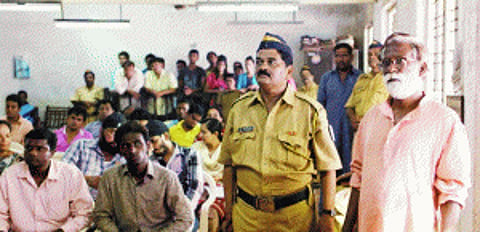

Writer-director Chaitanya Tamhane was making documentaries and short films before he stumbled upon the idea of Court. He tells Divya Kaushik how he managed to create the movie that has gained worldwide recognition with a shoestring budget and non-professional actors
One wonders what is it about Court that has not just fascinated the jury at international film festivals and national awards but has also left the critics convinced that this is the “finest film of the year so far.” More than its hard-hitting narrative and honest portrayal of reality, it is most likely the director’s vision that converted the stereotypical drama into something that’s riveting. The director and writer of the film, Chaitanya Tamhane, lived with the idea for over a year and researched a lot about the subject so that the end product is not another court room drama, over the top and utterly dramatic, but a true picture of the Indian judicial system. The idea of the film was born out of his own curiosity to understand the proceedings in the court room.
“I always wondered what it must be like to be in the trial room and to end my curiosity I one day decided to attend a session at a magistrate court. What I noticed was humorous, appalling and fascinating. Nothing was like what I imagined or saw in most films. The constable was scolding someone for sitting cross-legged, lawyers were not prepared and there were trials happening for the cases of lost watches or against people found travelling in the ladies coach of local trains. There was a sense of chaos and most things were being handled with a casual attitude. I walked out and thought to myself that this is like an eye-opening experience that should be brought out on screen as it is. That was the beginning, thereafter I researched on the topic for about a year, met lawyers and other people in the judiciary for the first-hand accounts and then weaved the story that is engaging but at the same time not dramatic to drive away the essence of reality,” shares the film-maker.
Chaitanya decided to not go for professional actors for his film because he did not want the actors to come with any pre-conceived notions and create an illusion of what is not real on screen. After deciding on the story, he and his team went to scout for people who were willing to be a part of the film in banks, colleges and other public places. “All these are people who did not want to be actors. So it was quite an amusing experience to be approaching random people and asking them if they wanted to act. Some thought we were kidding and some were instantly excited. We did extensive workshops with these people after the auditions. Since we were shooting long scenes we used to sometimes take 30-40 takes in a day, but my idea was to give enough time to these people to present the reality as it is, without being influenced by any external factor,” shares Chaitanya who wandered with the idea of Court for a long time, looking for funds and that was when his friend Vivek Gomber, the producer of the film, came on board.
“Vivek acted in the play Grey Elephants in Denmark that I wrote and directed. Three years after that, when I was broke and was looking for ways to take the idea of Court forward, I met Vivek and discussed it with him. He decided to help and offered me a monthly salary while I wrote the story. When the story was ready, he really liked it and wanted to produce it. So I never really had to knock the doors of any studio or production house for the finances,” says Chaitanya.
The film draws many real-life influences but the director says that the setting is purely fictional. “It is not inspired by any one incident but is based on several true cases. I have taken the reference but the characters and story are fictional. You might find one or two similarities here and there. I came across the case of cultural activist Jiten Marandi in Jharkhand. He was falsely accused in a bomb blast. The suspect was some other Jiten Marandi but because they could not find him, they arrested this guy and he was sentenced to death. This case took me to other activists and more cases,” informs Chaitanya.
Court premiered at the 71st Venice International Film Festival last year and won the best film in the Horizons category and the luigi De laurentiis (lion Of The Future) award for Chaitanya. The film went on to win 18 other awards at film festivals, including honours at the Mumbai, Vienna, Antalya and Singapore film festivals and it winning the best feature film award at the national film awards was like a cherry on the cake. Chaitanya feels that worldwide recognition surely helped the film create buzz. He says, “I still feel that there is a gap between the commercial films and films like Court but I would say that the awards got the film the attention of the masses, which was very important for us as the film is based on a relevant subject.”
Court happens to be one of those multi-lingual film that is not driven purely by the language to take the story forward. The film-maker says that he deliberately wanted to make a multi-lingual film so that it comes across as a true reflection of the present-day Mumbai. “I was born and brought up in Mumbai and I have seen people of different cultures co-existing. You walk on the streets and you hear people talking in different languages. Even in the court room, the lawyers would narrate the law in English, the two Marathis would only talk in Marathi and then the third one present, who would be a Guajarati, would object to that. I have used Hindi, English, Marathi and Gujarati in the film and all these are elements and props for me to keep the portrayal real in every sense,” says Chaitanya, who is a self-trained film-maker and has learnt everything while on the job.
He was graduating from Mithibai College, “which has a vibrant theatre culture,” and during his graduation he got interested in theatre. After writing and directing a play Grey Elephants in Denmark, which is a story of a magician, he directed a documentary on plagiarism in India and a short film. “I was never really interested in commercial films. Even when I watched Hindi films, I preferred films by Shyam Benegal and Mani Ratnam. When I was 18, I worked with Balaji Telefilms as a writer and met some people who introduced me to the world of cinema. It was a great exposure for me and I was absolutely thrilled by the brilliant work that we have from other countries. I then started writing and directing but I have no formal training in cinema,” he says.