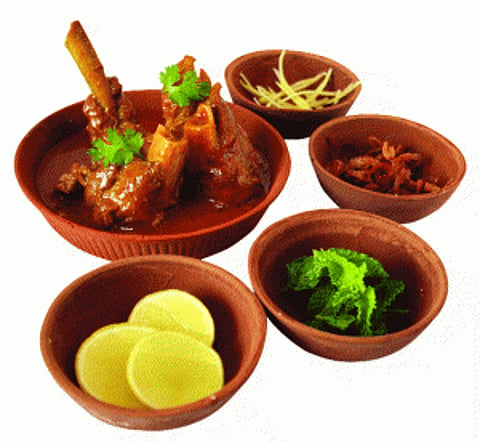

Chef Imtiaz Qureshi hosted a kebab and biryani festival at WelcomHotel Dwarka. He shared interesting anecdotes on Awadhi cuisine with Neeti Nigam
People who are well accustomed with Awadhi cuisine would know what it means to meet the living legend, chef Imtiaz Qureshi, a man who has revived the royal cuisine of nawabs of lucknow. For some part of the world, Awadhi became synonymous to Indian cuisine after he revived it. He introduced variety in kebabs, biryanis and curries. We met chef Qureshi while he was here recently to promote kebab and biryani festival at WelcomHotel Dwarka.
Dressed in his formal uniform, Qureshi was like a soldier on a mission. He told waiters what kebabs should be served along with what chutney before he sat to chat with me. Even after spending most of his time in the kitchen, the 85-year-old chef showed no signs of exhaustion.
He began the conversation by sharing some interesting anecdotes. “I remember once a Kayastha professor from lucknow hired me for his daughter’s wedding as the groom’s family only demand was good liquor and non-vegetarian food. During her vidai ceremony, professor hugged me and thanked me for serving the guests the most delicious dinner,” he said tossing his trimmed silver moustache.
In his long tenure as a chef, Qureshi has cooked for many high profile guests, including the Nehru family and many business tycoons. “Indira Gandhi’s sons were so much in love with sikandari raan that she used to personally call me to prepare it. I remember cooking for Nawab Pataudi and Sharmila Tagore’s wedding. No matter that both were popular personalities, the show-stealer of their wedding was my kakori kebabs. Even Amitabh Bachchan’s father was fond of kakori kebabs,” he reminisced.
I noticed “Salman Khan-type bracelet” on the chef’s hand. “Salman’s father, Salim sahib, is a dear friend and my morning walk companion,” he told me.
At the age of nine, Qureshi started assisting his maternal uncle at the royal kitchen in lucknow. With his exceptional culinary skills, Qureshi outshone his master. He later had to switch over to other hotels and brother in-law’s catering business, till he landed in ITC Hotels where he founded award-winning restaurant Dum Pukht.
“This is one place where prime ministers and other dignitaries enjoy eating,” said chef proudly. “When Bill Clinton came to India as the president of US in 2000, he hosted a party for his team at ITC. I made kebabs of prawns, fish and other meat with each possessing distinct flavour. He was happy with my work. In fact, later when Hillary Clinton came on an official visit, she took kitchen training from me,” he added.
But the most challenging task was probably when he was given the responsibility to prepare food for the prime minister and other bureaucrats during the Indo-China war in 1962.
“They trusted me and I didn’t let even the security personnel touch the vessels. My mother was apprehensive, she kept fast and read namaz for the entire day,” he shared.
like any good host, he made sure that delicacies were served properly during the conversation. Some of them were gosht ke pasande, murgh joshila, gundum ke tikke and dahi ke kebab. Each was different from the other in terms of flavour and aroma.
“Who says kebabs can’t be eaten in summerIJ You have to use raw papaya and less ghee for easy digestion. The formula for making good kebabs is balancing each ingredient. If you add more papaya, it can be acidic,” he said. Gundum ke kebab is chef’s latest innovation where gluten cakes are soaked in pomegranate juice, marinated with Kashmiri chilli masala and finished on clay oven.
Chef Qureshi was so particular about his biryani that he personally went to the kitchen to remove the lid. “If you don’t open and mix it properly, dum biryani’s flavour can change,” he informed.
Till he returned, I savoured succulent zaituni gosht ki biryani followed by gosht nahari, chooza mussallam, badam dal and paneer anari along with mughlai paratha. Chef returned and told me, “Earlier we used the wood from babul, imli and mango trees to cook biryani. Their aroma added distinct flavour. The food was cooked in polished copper utensils.”
Shahi tukdawas served as dessert. “There is a wide variety of desserts in mughlai which this generation has not even heard of. I remember preparing mutanjan (meat, rice and sugar-based dessert) at one of Rampur’s nawabs wedding. Though he loved the entire menu but for this particular dessert, he said that the only way he could compliment me was by giving away his sherwani,” he said.
Qureshi ended, “I get satisfaction in cooking and making people eat but now I sit and eat with my guests.” The festival is on till June 19.