
Astaguru’s No Reserve auction offers glimpses of the works of masters when they were a work in progress themselves, says Uma Nair
If you are looking to collect art, then you must participate in Astaguru’s auction of the season. What makes it so appealing is the fact that there is no reserve price contingency and the final bidder takes home the lot. Furthermore, all bids start at Rs 20,000 which is a great entry point for the quality of works that are put up for auction. All of the 100 lots that are part of this auction have been shortlisted only after they have been researched upon. The works include lots by eminent artists like Jamini Roy, Ganesh Pyne, MF Husain, Anjolie Ela Menon, Nandalal Bose, Jehangir Sabavala, FN Souza and SH Raza to name a few.
Mother and Child
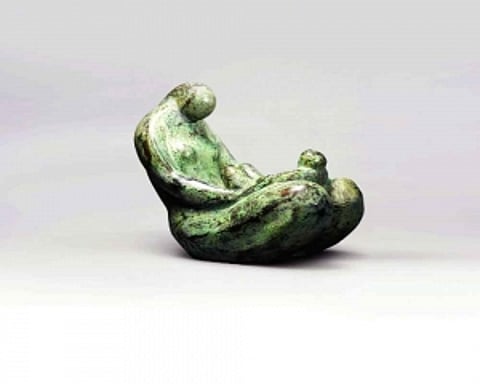
The relation of a mother and a child is one of the most universal inspirations that we see in all art forms since the beginning of civilisation. In this sale, there are two gems — one being Jamini Roy’s Mother and Child, 1950, a tempera on card, the other being Prodosh Dasgupta’s bronze sculpture with the same title. Both the artworks are intimate, tender, full of expression and have a certain sophistication of simplicity about them.
Roy’s work is a characteristic of folk art. Minimal albeit sharp shadowing on tempera lends it a charisma. The grey-light palette, enlivened by hues of deep grey as well as the very elongated almost feather-weight drapes of her sari, may have been inspired by folk and rural symbolism. In Dasgupta’s single piece of bronze, we see a modernist mould, a balance of bronze and entity as we are reminded of Henry Moore and his many Mother and Child series. The beauty of both these images shows devotion and deep love as well as a combination of styles and influences that nonetheless depart from the prevailing interests of early Renaissance artists.
Priest
Souza’s Priest, with a series of three churches behind, is a dulcet drawing created in 1958. His limpid lines and clarity of expression are what excite the art lover. It is a character of ugliness, not kind in any manner of speaking. Souza’s major formative influences were Georges Rouault, Chaim Soutine, Picasso and the Indian sculptures of Mathura and Khajurao.
From Roualt, Souza borrowed the frontal, icon-like compositions, the line-bound figures as well as the thick and porous application of layers of paint; from Picasso, the use of Primitivist idioms and from Indian sculptures, the erotic, highly plastic and organic figure-handling. His subjects included Christ, iconic saints, church functionaries, female nudes and a wide selection of social tropes. In 1957, Souza was awarded a prize in the Junior Section of the John Moores Liverpool exhibition. In 1958, he was selected to represent Great Britain at the Guggenheim International Award and in 1959, his work was exhibited in the US, Germany and Sweden.
Oil on canvas
The late landscape genius Ram Kumar’s Oil On Canvas is a treat for tired eyes. In this work, the landscape became its own architecture. Ram Kumar commemorated vast, epic images — the whirling onslaught of the storm, the descent of ragged forests along the courses of swollen rivers, the bronze echoes of the sun roaring above the cliffs, an eclipse falling like the shadow of a great bird over honeycombed ruins, glaciers and fault lines. The paintings of this phase defined the artist’s hallmark palette of ochre, ultramarine, sienna and viridian. They carry a sharp whiff of pine from the Shivaliks, the Himalayan foothills.
Apocalypse and renewal, nostalgia and hope were the themes of Ram Kumar’s idiom. The world is at a slant in these paintings — askew. It seems that everything is about to change its form — the soaring wedge of the mountain, the tumescent fork of the watershed, the streaming avalanche, the floodburst.
GR Santosh’s Untitled work
Another precious work is GR Santosh’s abstract artwork that embraces geometry and symbolism at its best. Santosh was a poet, thinker and a practitioner of transcendent yogic meditation. His art was born of his meditative experiences and so we see modern mandalas in his work. He uses elements of nature to create a yogic semblance that has a trademark symbolism of sheer ingenuity and the idea of Purusha Prakriti.
His meditative landscape is a dynamic equilibrium of floating planes. They are triggered by weightlessness and the directional vectors are all combined to form a meditative frame, precisely because they have moved from the perceptual to the conceptual, from semblance to structure. Architecture and long-looped identities symbolise the embodiment of energies and inertia, the simultaneous religiosity and spirituality of an individual who sees a civilisation in the twilight patterns of the sky.
For Santosh, the sky and the mind became the place of the living. This untitled work looks like a serene mandala in the sky, unbroken by the clouds and rays of the sun. Santosh’s oil on canvas force an awareness of the absolute nature of both birth and death, while also countering that life is an elegant gesture of the affirmation of presence.
(The auction ends today.)