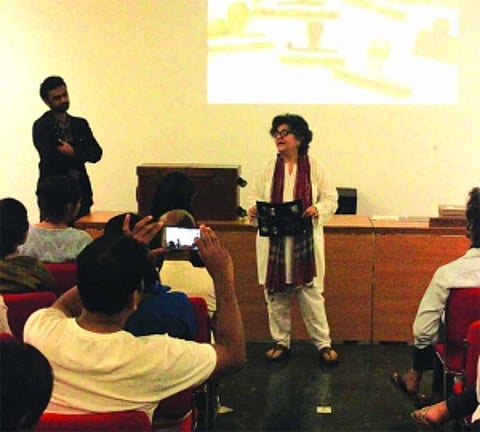

Photo essayist Dayanita Singh says it's a thrill to go a museum alone at night. She emphasises the need to bring conservation into museums, have coffee chambers in them, introduce nano museums and rejoices that photography has the largest language now. Saritha Saraswathy Balan listens in
She is all that she wants to be - a photographer, archivist, collector and a writer who ‘creates’ books with images and texts. Now she is advocating the currency of mobile and nano museums, declaring that she can’t be a confined to four walls. In other words, she carries a book box, a thick tome which contains slides of her work and text that can be pulled out as easily as you would a rabbit out of a hat.
And only a self- assured person like her can hold up a triangular wood piece in front of a packed audience - on which her three roles are written - director, curator and registrar, to assert what she is .
Dayanita Singh is in absolute love with making books, which she calls a ‘deep need’. Says she “Even if nobody is there I will not stop compiling books. I will go to the footpath to sell my books. If 10,000 people pass by them, at least ten per cent of them would look at them, which would be enough for me. Some people ask me to stop this and come with something new. But I can’t stop it, I am thinking of how to make it better instead”. Her book box contains 10x10 inch prints of what she has captured of life.
It is concurrently a book, an art object, an exhibition and a catalogue. It shows how it’s possible to transcend and transform it into even a museum. Singh then says that 3000 books will be printed out of her collection, but the box for each book will be different.
She carries the suitcase with these books, saying that she is ever ready to conduct an exhibition. A fixed installation on a museum wall no more attracts her. For her a museum should be a dynamic space. “Some people say that they go to Taj Mahal at night to have sex. I don’t like that but I love going to a museum alone at night. It’s a thrill doing so. There needs to be interaction at museums, bring some furniture, architecture and a set up a coffee cubicle so that people can come and talk”, she says.
“I can’t stand a still life of a museum, when an artist is alive. I don’t quite fit to the art world, it’s limiting to me. Museums want things in order . But a suitcase museum is dynamic. I want to put things on walls where I can change them continuously”, she says. Why does she carry tiny prints of her photographs with her IJ “People have wallets in their bags, you never know when you suddenly have the idea of a news sequence. For that this kind of print is crucial. It's such a physical object to find new stories or sequences. This is my most valuable wallet with which I travel everywhere. With little, little books, its now a big bundle”, she says. “If I want to conduct an exhibition , I will take my suitcase with these prints and do it. I love having a problem”, she laughs.
She is sarcastic about those who claim themselves as photographers, since photography has the largest language and everyone with a smart phone has access to it. Singh says, “What is important is finding the right form and right text for it. That is the caption we give to a photograph, which would completely turn around the image. I don’t know how many do that”.
She is adamant that she won’t welcome those who don’t treat her as a writer as well.
“Selling of books is also very important. For me I won't give you a book free. If you need one , you should buy and you should directly buy from me. I have a book shop in front of my house. Art world means you need something solid to sell. If you need my show, you need to buy my book as well. Otherwise it implies that you are not interested in my work, but in my name only”, she says.