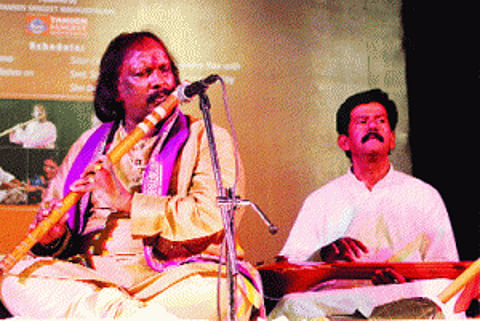

Rajendra Prasanna is the third generation of flutist of the Banaras Gharana. He shares his childhood memories of training and the present scenario of Indian classical music with Sonali Arora
The hall was drenched in luminous yellow light and was abuzz with the light chitter chatter of the audience who eagerly waited for flutist Rajendra Prasanna to mesmerise them. The hall fell into silence when the maestro took to the stage and gave a beautiful rendition of ragaSaraswati. The audience listened in rapt attention as the melodious notes flowing from his bansuri were mesmerising and refreshing like the sound of pouring rain. His recital was further enlivened by Abhishek Mishra, who accompanied him on the table, Rajesh Prasanna, one of the maestros kin, on flute and Shahbaz Khan on the tanpura.
The auditorium at the India Habitat Centre came alive when he played raga Kajari. He paused briefly in the middle and humbly asked his listeners to applaud only if they appreciated the music. His devotion and dedication towards his family traditon of flute and shehnai playing was visible in his face as he tirelessly played a few more ragas.
Rajendra Prasanna hails from the Banaras gharana, who have most poignantly contributors to the world of classical music. He is the third generation of flute practitioners and credits his skills to his father and uncles. “It was my father, Pt Raghunath Prasanna, who introduced flute into the Prasanna gharana of music. He has influenced the way flute is being played in India today.” He fondly shared his upbringing in a gurukul environment wherein he remembers to have constantly practiced music for eight to ten hours every day, under the guidance of his father, grandfather and uncles. “I have tried to pass down the precious knowledge of music I have inherited from my father onto my three sons. All three continue to associate themselves with this line of music in their own way,” added the artiste who has a Grammy certificate to his name.
Although he is proficient in playing both flute and shehnai, he prefers the former over the latter. He elaborated on the difference between the Indian bansuri and western flute saying that, “Bansuri offers scope for improvisation where as the western flute with the keys restrict the musician in a way. The former can be used to play jazz music as well as Indian ragas but the latter can only be used for jazzy notes.”
According to him, the classical music scene is reviving in India. It is expanding and is coming out of its niche corner. With music enthusiasts in west appreciating Indian musical talents like Pt Ravi Shankar, Ustad Amjad Ali Khan, Hariprasad Chaurasia, MS Subbalakshmi, the audience in India is also witnessing considerable growth.
The NGO started by Pt Devashish Adhikari, Parampara, which staged his breathtaking performance is an intitiative to promote indigenous art forms like classical music and dance. It received a warm applaud for bringing together the stalwarts of the musical world like Rajendra Prasanna, Subhendra Rao and Saskia Rao-de Haas. Saskia, who has been mentioned by Ravi Shankar as the disciple of God when it comes to music, ignited the stage with her cello performance in collaboration with her husband the renowned sitar player Subhendra Rao.
photo Pankaj Kumar