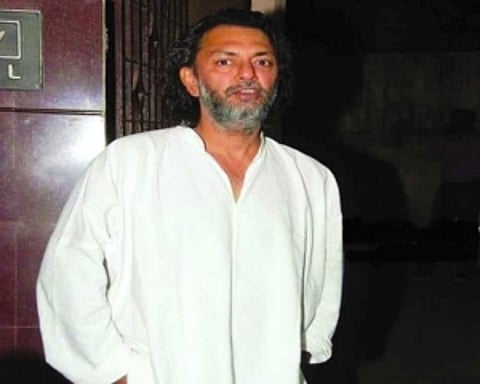

Rakeysh Omprakash Mehra does not believe in giving sound bytes. A discussion with him turns out to be deep, meaningful and in-depth, discovers Saimi Sattar
This needs a sit-down discussion rather than a phone conversation,” quips a faint voice at the end of a twice-connected conference call. Director Rakeysh Omprakash Mehra is reacting to a long list of questions that I had sent to him earlier. Without missing a beat, I immediately respond, “That is because I’d been wanting to do this since I watched Rang De Basanti 15 years back.”
The reason isn’t tough to guess. All of us distinctly remember why words like ‘cult’, ‘classic’, ‘inspiring’, ‘thought-provoking’ were descriptions that became intangibly attached to Mehra’s second outing. In a curious case of life imitating art, it ignited a popular protest and channeled the rage of a generation which assembled at India Gate after the murder-accused in the Jessica Lal murder were released soon after the film hit the theatres.
Maybe the reason why it touched a chord was that Mehra and writer Kamlesh Pandey touched the pulse of the youth. Earlier, they had scripted a film which included the Jallianwala Bagh massacre, Kakori train robbery and the bombing of the Assembly by Bhagat Singh, Rajguru and Chandrashekhar Azad which resulted in them being hanged. “I wanted to make a film on the armed revolution and it was called Young Guns of India. I bounced off the idea of the script off the students and it was evident that they didn’t identify with it (or with the protagonists who were in the same age group). They weren’t interested in the ‘idea of India’. So, we went back to the drawing board and rewrote the script.” Mehra had realised that even if they made a good film about the people who lost their lives in the armed resistance, it wouldn’t serve any purpose. “It will be entertaining, people will sing its songs but that wasn’t why I was making the film,” says Mehra and adds, “Unless I find a reason, I don’t make it.”
Speaking about RDB Mehra says, “It isn’t important if it became iconic. Results are results. Sometimes your voice gets through, at other times it gets lost and, at other times, it gets amplified. What is sad is that the film is still relevant.” An opinion which he hasn’t shied away from expressing time and again is that despite the spiralling popularity of RDB, corruption, which it had targetted, hasn’t disappeared. “It normally doesn’t. But nations can definitely move in the right direction. The law of the land can be more effective and I don’t see that happening in at least the last 20 years,” he says matter-of-factly and without a trace of emotion.
Another social reality which not just RDB but also his later films Delhi-6 (2009) and Bhaag Milkha Bhaag (2013) more than hinted upon was that of religious divisions — subtle and more pronounced — within the country. Aslam, the only Muslim among the group of five friends, is derided as a Pakistani; Roshan, the product of a mixed marriage witnesses Hindu Muslim animosity when he comes to India; Milkha, a Sikh, is forced to run away from what became Pakistan. “Isn’t that a good thing to criticise religious divisions,” asks Mehra. But haven’t the religious divisions sharpened compared with the time when the films were made? “I can’t comment on the choices people make. I can only do what I can do... not in an immoral, biased or angry way. There are already so many wounds. There is no point in scratching them. You might as well apply a soothing balm. If the films somewhere carry a hidden message of peace and love, it’s the right thing to do. Especially since the films go out to millions of people and are the collective subconscious of the nation. Though it is a good medium, it depends what kind of cinema people want to watch.”
Outside films, Mehra has been critical of the education system in no uncertain terms. “It’s completely redundant. Education needs to be reborn and seen from a new light. The world has changed and continues to change so fast that what children study at school isn’t relevant. Learning is important and being ahead of the curve even more so. I can’t understand this whole system where children are aiming for 90.6 per cent, 99.6 per cent and more,” he argues and says that unless a student is planning to pursue a professional course — like medicine, which entails saving lives, or engineering, which incorporates building bridges and the like, — institutions can’t have a system where “students aren’t eligible”. He feels that this is undesirable for a reason. “When you put people under intense competition in their formative years and under a system of Hindi and English medium, you’re dividing and segregating people at the outset. It goes deeper in the form of gender bias as boys are favoured. I think about making a film on it every day,” says Mehra who was a part of the selection camp as a swimmer in the 1982 Asian Games held at New Delhi but wasn’t selected in the final round.
Music has been central to his films and the songs continue to be popular years after these hit the charts. In fact, while remixes often give a new lease of life to songs, in the case of Masakali from Delhi-6, the adverse reaction broke the internet. “Music is a very important part of life and expression in India. While there’s bhakti, classical or folk music as well as independent music, which is now shaping up, it’s the one in films that can be called popular music. The second reason is that films have grown out of folk theatre which was musical,” says the Air Force Bal Bharti, Delhi alumni. Mehra lists a third reason why music is central to films. “Some of us use it as a narration or as an abstract or third voice. What you want to say and its subtext can be taken forward by music,” he asserts.
In RDB Mehra consciously decided not to have lip-synced songs or choreographed dances. “We’re evolving. Slowly we’re telling stories both musically and non-musically...This, in, itself is a conversation worth many hours,” he says.
Of the seven films that he has directed, A R Rahman has been the composer thrice and Shankar-Ehsan-Loy have featured four times. But he doesn’t repeat actors very often. However, for his forthcoming, Toofan, Farhan Akhtar is playing the lead a second time after Bhaag Milkha Bhaag. “For a normal audience what they see is in front of the camera. I’ve repeated myself and that’s not funny!” he says and explains his reasons. “You might share a relationship that brings out the best in you and you want to take it to the next level. That’s definitely what happened with Farhan. This time we have enjoyed ourselves much more. What he brings to the table is intangible,” he contemplates. The quality that Mehra likes about the actor is that he doesn’t play the part but rather becomes it, which is important to the story writer. “I want the audience to enter the theatre and see the character and not their favourite star. Even if they are drawn by the star power but 10 minutes into the film, they should forget it. In fact, even I, the director and the camera, should become invisible,” says the 57-year-old.
Mehra has had a diverse trajectory even in the heptad of films that he has directed. “You want to say something that moves you, gives you sleepless nights ... because you want to tell that story to the world. Sometimes you feel that you managed to say that in one go but at other times it takes two or three films to achieve it,” he says and demonstrates it by way of his work. In Aks (2001), his debut film, he tried to say that good and evil are two sides of the same coin. “In Delhi 6, I attempted to show that good and evil are inside you and when you look inside the mirror, you find Allah, Bhagwan, God and Jesus ... and also the devil and the kaala bandar. The choice is yours. I felt that I touched upon it but it became a little intellectual,” admits the director about the film which won the Nargis Dutt Award for Best Feature Film on National Integration at the 57th National Film Awards.
He picks up the thread again and says, “In Bhaag Milkha Bhaag he was running away from the past all his life. Milkha hated the Pakistanis and he got the biggest honour from the place where he lost everything... including the title of the ‘Flying Sikh’. After that, when he turned around, he sees his childhood smiling back at him. For me, the answer was that you you have to face your demons and take them along with you. The only way to nullify them is to look them in the eye,” he says sagely.
Not just in his films but overall the content has changed dramatically. It has been powered by the audience feels Mehra who says, “Films directly or inversely reflect what is going on or they predict what is going to happen or they juxtapose the two. When the country was born, there was hope so films reflected that.” But this enthusiasm was punctured by the Bengal famine, Maharashtra drought, corruption, joblessness, the loss of China War, constant strife on the Pakistani border and so “Devdas, an escapist and an alcoholic, became a hero. The hero started dancing with the birth of escapism, around 1966-67, which he is still doing. Before Shammi Kapoor the hero never danced.” However, he doesn’t dismiss escapist cinema as it served the purpose of giving the audience a respite from their own bleak lives. “The rhetoric and propaganda in our films mean we are still living in an escapist environment today. Even when you objectify a woman, it means that society has still not come to terms with her and is unable to accept her as an equal. The audience tells you when the stories should shift and change,” says Mehra .
However, he feels that OTT is a distribution mechanism and has nothing to do with telling a story. “Earlier there were single screens, then there were multiplexes and now the screen has shrunk to your palm. When people watch my films on a mobile, I cringe because I’ve worked so hard on the picture, sound, cinemascope, 70 mm. Your storytelling has to be ahead of its time and technologically agnostic,” he says and gives RDB as an example which people loved on the big screen and still do on TV.
Though he feels that he can’t make a series for OTT as he prefers feature films but he believes that the best thing to do is to embrace change. “The added benefit of the digital platform is now that the reach of work is much wider.
After the sports drama film, Toofan, is released Mehra intends to do a lot of meditation. “There is so much happening that I don’t know what to pick up. There are so many other projects lined up and then I open the newspaper and I feel I need to say something about this or that. You have caught me on the wrong foot as I am on the crossroad but soon I’ll have to take a call. Within one month or one and a half at the most,” he promises. And we will wait for another film that would ignite conversations.