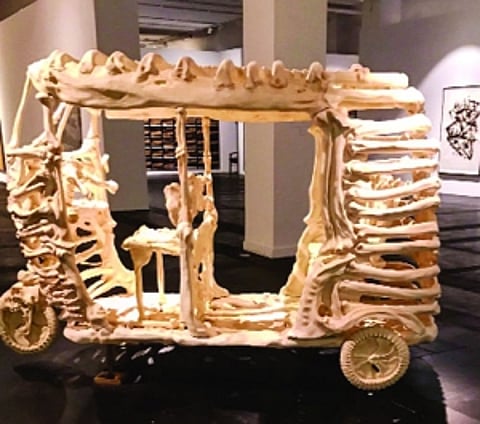

Uma Nair highlights the masters who did good and the highs and lows of auctions
2017 saw numerous shows, auctions featuring India’s contemporary artists and modernists. From installations to drawings and heady canvases, it was a repository of talent that brought to the fore the import of an idiom that evolved over time with the experience of exploration. The mystic Simone Weil wrote: “Time is an image of eternity, but it is also a substitute for eternity.” And while some shows personified that allegory of immortality, auctions had highs and lows.
Tyeb Mehta’s Rickshaw at Christies creates new record
The 22nd edition of the annual london South Asian Modern and Contemporary Art auction realised the highest result for any sale in this category till date. A total of £5,901,625 /$7,660,310 was achieved with exceptionally high sell through rates of 91 per cent by lot and 95 per cent by value, again the highest of any auction conducted in the category this year.
Tyeb Mehta’s (1925-2009) Untitled (Woman on Rickshaw) painted in 1994 was sold for £2,741,000 /$3,557,818, setting not only a new world auction record for the artist, but also becoming the most expensive work of South Asian art sold globally this year.
The auction celebrated 70 years of Indian Independence and the Progressive Artists’ Group (PAG), which was founded in 1947. The founding members included the masters Francis Newton Souza, Maqbool Fida Husain, Syed Haider Raza, Sadanand Bakre, Krishnaji Howlaji Ara and Hari Ambadas Gade.
Arpana Caur’s 40 Years, NGMA
To look at a painting by Arpana Caur is to be drawn into the world of a woman. To be caressed by the neatly delineated contours of the brush of the finest figurative artist in India. No one can create a supine or yogic squatting human character on canvas the way Caur does and this was the structural firmament that greeted one’s gaze at the NGMA Bangalore, where she celebrated 40-years of work presented by Swaraj Archives. Dualities, social commentaries, transcendental trajectories, objects swirl and scatter like surreal leitmotifs laden on tales woven from antiquity to meet present day reality. It showcased the brilliance and the passion that Caur has.
Atul Dodiya, Vadehra Art Gallery
One artist who can create a show that unravels like a masterclass for art buffs is Atul Dodiya. His Girlfriends at Vadehras had a series of drawings that harked back to the haunts of history and Dodiya’s penchant for the beauty of basics. The female figure, says Dodiya, connects these works which draw on 2,100 years of art history, from the first century BCE to the 20th century CE and takes inspiration across geography, from Arezzo in Italy to Santiniketan in West Bengal. “Since there are so many female figures, I thought if I called them my girlfriends, that would be so special and beautiful,” said Dodiya.
Jitish Kallat, NGMA
The year began with Jitish Kallat’s mid career retrospective at NGMA Delhi from his epic work, Epilogue, memorialising his deceased father’s lifetime through the invocation of 22,889 moons depicted through phased out rotis he saw.
Here After Here...embodied infinite realms that constituted Kallat’s artistic practice from 1996 to 2017. The mid-career retrospective marked a seminal moment for art lovers to encounter the immensity of his artistic gestures, particularly his Public Notice shown in Chicago.
The title also furthered Kallat’s investigation into the relationship between the mundane and the cosmic, especially since the upcoming exhibition displays works such as Forensic Trail of the Grand Banquet (2009), a video piece containing footage that appears to feature unchartered territories in outer space and its many landmarks as they float in front of the viewer, evoking the forms of cellular organisms that are in-fact X-rayed images of food.
Jyoti Bhatt’s vintage photographs at Rukshaan Art
The celebrated printmaker, Jyoti Bhatt is turning heads in Mumbai with his vintage suite of photographs at Rukshaan Art. Images that go back to the mid 60s, demonstrating great artistic sensibility, creativity and a unique understanding of traditional cultures.
Bhatt began documenting the folk and tribal culture of rural India in the summer of 1967. He travelled widely, photographing folk arts and craft traditions in their original environments, along with the people who inhabited these spaces — much of his work records village and indigenous art forms, synthesising human figures with static backgrounds that show painted, or drawn, images on walls or floors. The images celebrate rural rhythms in India that provide experiential insights and highlights the history of photography in India and its challenging.
Sudarshan Shetty’ Shoonya Ghar
Sudarshan Shetty the curator of KMB and the pioneer of installation art in India has transformed the lawns of the Bhau Daji lad Museum in Mumbai with his installation Shoonya Ghar.The multi-media solo show draws from the multiplicity of Shetty’s art practice using sculpture, found objects and film, and explores the artist’s own cultural history through his memories of personal and public space.
Based on a rhyming couplet by 12th century poet Gorakhnath, the show explores the dual concepts of abundance and nothingness. Haunting and allegorical is the central architectural structure made from reclaimed wood sourced from various parts of India and Ahmedabad.
Shetty, who is acclaimed for his innovativeness and versatility, has been deeply inspired by traditional poetry, drama and theatre, with the dichotomy of the past and the present always seeping into his practice. Shoonya Ghar is Shetty’s tribute to a poet (Gorakhnath) and a singer (Gandharva), both of whom followed an unusual style of rendition of Nirgun Bhajans. Nirgun means “without attributes” and is an abstract form of musical practice that creates dissonance in a melody, giving importance to momentary bits of silence that can be quite mesmerising for the listener. It is this mystic, dramatic effect and spirituality that Shetty seeks to weave into Shoonya Ghar.
Subodh Gupta, Smithsonian Institution
In terms of installation practices, it was Subodh Gupta’s Terminal 2010 that proved to be an immersive experience at Smithsonian in Washington DC. The 50 ft tall, spectacle tenured spindly golden spires connected with white thread was an allegory of architectural dictates at temples, mosques and churches replicated in the pavilion of the Smithsonian’s Arthur M Sackler Gallery in Washington DC.