
About the Book
Book: Ratan Tata: A Life
Author: Thomas Mathew
Publisher: HarperCollins
Price: Rs 1499/-
‘Ratan Tata: A Life by Thomas Mathew,’ offers a compelling tribute to India’s legendary industrialist and philanthropist, says KUMAR CHELLAPPAN
The demise of an 87-year-old human being is neither shocking nor does it bring everlasting grief to the mind. If the deceased happens to be our father, mother, brother, or sister, we may be in a sense of bereavement for a couple of months. The general feeling among us is that each day that one gets after crossing the age of 60 is a bonus from Yama Raj. But there are certain persons for whom we pray to God Almighty to bless them with a much longer life. Ratan Tata, India’s legendary industrialist topped the list of such people who made this world a much better place because of their presence.
The entire Indian society, barring a Malayalam satellite news channel, received the news of Ratan Tata’s demise with a pang in their hearts. Born into a Zoroastrian family (popularly known as Parsees), Ratan Tata lived a life based exclusively on the essence of Zoroastrianism-Humata, Hukta, and Huvarsta (good thoughts, good words, and good deeds). For Ratan and the Tata Group, industry and business were means to serve humanity, either through philanthropy or social service. The catchphrase “We Also Make Steel” campaign launched by TISCO, the flagship company of the group, speaks volumes about the mission of this industrial conglomerate.
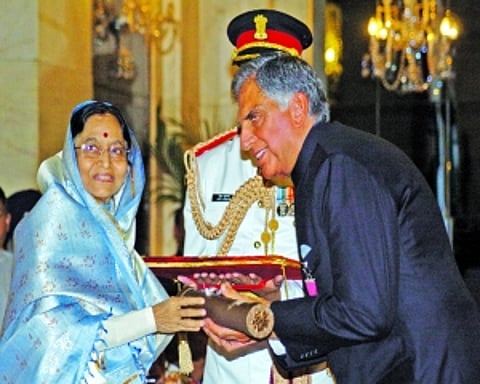
No doubt, the central government had honoured J.R.D. Tata and Ratan Tata with Bharat Ratna and Padma Vibhushan, respectively. But it is still doubtful whether the powers that be gave these great sons of India the honoursthey truly deserved. J.R.D. Tata, predecessor to Ratan Tata, did all he could to elevate the country economically and socially, despite the outdated socialist ideology that prevailed from 1947 to 1991. He had been pleading with the policymakers to loosen the government’s shackles over the economy, which would have made India competitive in the global arena.
It is said that for every industry launched by them, the Tata Group set up institutions like schools, colleges, vocational training institutes, hospitals, and old-age homes.
During the 1980s, I do remember watching J.R.D. Tata interviewing the then World Population Council chairman who visited India. It is rated as one of the best interviews in Indian television. Imagine-the numero uno of our industry, who is held in awe by the world, appearing on Indian TV to interview a guest!
The second TV programme featuring J.R.D. was also broadcast by Doordarshan-it was an interview by Rajiv Mehrotra in the famous series “In Conversation,”
a popular talk show. Interestingly, those were the days when there were no satellite TV news channels and “angry young anchorpersons” who interrogated the interviewees instead of interviewing them.
There are exceptions, like “Rendezvous with Simi Garewal,” in which the diva of Hindi cinema interviewed the crème de la crème of Indian society. They were all talk shows shot inside aesthetically designed studiosand, hence, the series could not always capture the real person being interviewed. But with all due respect, it has to be said that Simi Garewal did a wonderful job. She successfully brought to our drawing rooms personalities like Ratan Tata (the first time I saw Ratan Tata appear on a TV show).
Ratan Tata: A Life authored by Thomas Mathew, a former IAS officer. I do not know whether there are any other books on Ratan Tata.The 666-page book is a moving tribute to Ratan, who was once described as the Most Eligible Bachelor of India. Ratan reached the zenith of Indian industries not just because he was born with the surname Tata but because he was destined to become the monarch of everything he surveyed.
Mathew has incorporated the reminiscences of Ratan Tata’s college mates, friends, relatives, and colleagues to portray the real Ratan, who was rather media-shy and always kept away from the glare of publicity. How Ratan, once voted as India’s most perfect gentleman and seen as the apparent heir to J.R.D. made the Tata name a global brand is a corporate folklore of modern times.
But what makes Mathew’s book unique is his description of the relationship between Ratan and Navajbai Tata (widow of Sir Ratan Tata, second son of group founder Jamsetji Tata). Navajbai adopted Naval Tata, father of Ratan Tata, from an orphanage. The latter treated her as his own grandmother. Navajbai ensured that Ratan was kept abreast of the history of the family, and she was a window to the world for the young boy.
Till her last breath, Ratan was at her side, giving back the love and affection she showered on him. This is an important part of this book and an eye-opener for modern-day parents, who deny their children the chance to interact with their grandparents.
Mathew’s book may not rival Boswell’s Life of Samuel Johnson, but the fact is that this bureaucrat has succeeded in telling us about a person who may be one of the last links between economic liberalisation and the license-permit era. This Tata was the real Ratan on the crown of Bharat Mata.