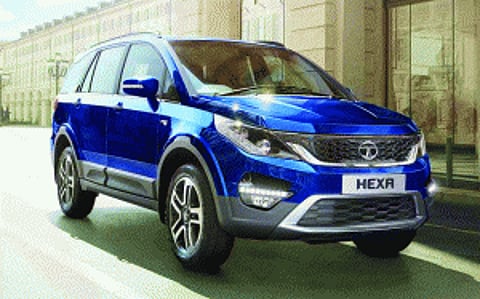

This column is about the Tata Hexa, which is Tata’s attempt to make a better MPV, or minivan, whatever you choose to call it, not a dinosaur. This is a segment that the carmaker had entered with the Aria, and frankly the Hexa is a much-tweaked version of the same. Now, the Aria despite its good looks had the driving characteristics of a truck. Does the Hexa improve on thatIJ
The simple answer is yes. But the bigger question when it comes to affordable minivans is whether you should choose a Hexa over the Mahindra XUV or just spend a some more money and buy the Toyota Innova. That is not a question easily answered even after spending a weekend with the car. But there are some clear improvements on the Aria, indeed after watching all the Hexa adverts online and on television, one has to agree with the contention that Tata has really spent some time on the car.
The version tested was the top-of-the-line XTA variant which comes with all the toys and the Varicor 400 engine mated to a six-speed automatic gearbox. The 400 in the engine name comes from the amount of Newton-meters of torque the car produces. Which is a lot, enough for the car to pull a Boeing 737 as one of the adverts that helpfully come up every time you put on YouTube never fails to remind you. It also produces 155 horsepower, which is well, decent, because the Hexa is very large and very heavy car; so the ‘Sport’ mode that appears complete with the instrument cluster turning red when you accidentally move the shifter to the left is well, a bit funny to say the least.
That said, stick to the highway speed limits and the Hexa does so uncomplainingly and rather economically as well. An average of around 10-11 kilometers per litre (as the car’s computer said) in combined city and highway driving over 200 kilometers isn’t bad for something this large. The six-speed automatic gearbox is not the faster shifter under the sun but particularly lazy either. So if you want to move a plane, this car is perfect, just as long as you don’t want to go too fast.
Now to the best part about the Hexa, and the single biggest improvement in this vehicle from the Aria. The suspension. The car that I drove had done the media rounds and had clocked in quite a few kilometers. Usually, cars in the media fleet treated worse than a towel next to the basin at an Udupi restaurant. Despite that, this car smothered bad roads; it literally battered through them. And here is the funny thing, usually when a car is setup to be smooth you pay for that in poor directional control and body roll.
While this is a big car, and one treads with caution while headed into corners with vehicles of this size, it did not feel like you were the helmsman on the Titanic trying to avoid an iceberg. Impressive enough to give one the confidence to go slightly faster into corners. You don’t get out after a day of driving with your sides aching having being constantly pushed into the side bolsters. That said, this is not a small hatchback that you just throw into a corner, but impressive work from the suspension engineers.
Interiors. Well, you are reminded that you’re in a Hexa, because there is a large ‘Hexa’ imprint above the glove and another below the USB and power connectors. A few more hexagonal touches like on the front radiator grille on the inside might have been nicer. The interiors feel nice and rear seat comfort on the six-seater variant which I drove was quite nice indeed. Personally, I’ve never been fond of white interior lights in a car, so a minus there. I know Tata Motors have spent a lot of developmental work on their ‘ConnectNext’ infotainment system but the Hexa lacks Apple CarPlay and Android Auto support. And while the screen is a touchscreen, the screen size felt miserly. And for a top-of-the-line variant in India with no navigation support nowadaysIJ What is thisIJ 2015IJ It has to be noted that the Hexa’s immediate competitor does have navigation support.
So should you buy oneIJ You get plenty of metal, and the Hexa is an impressive beast to look at from outside, especially the higher variants with their machined 19-inch alloy wheels. And it is a large three-row car with an usable third row without luggage space being completely compromised, and at Rs 17.4 lakhs it compares favourably against a similarly-specced two-wheel drive XUV. But the top-of-the-line Innova Crysta with bigger diesel engine and an automatic gearbox costs four lakhs more. Yes, that is a lot more money, but not massively more more money. True, the Hexa is much improved over the Aria, but still not great enough to turn someone away from the Innova.