
Khushbu Kirti couldn’t take her eyes off the magnificent art-work displayed at Episteme at Art Centrix Space, New Delhi
As I entered the Jain farms on a November evening with nothing but chilly wind brushing against the skin (no it’s not a Jane Austen novel, wait for it), I had no clue the magnificent art displayed at Episteme would blow me away. I will not exaggerate a bit when I say the convolutedly beautiful layers that each and every art-work presented forced the spectator to not blink, forget about looking away.
I walked through the outdoor sculpture lawns, into the expanded galleries that encompassed the art-work which evidently spelt beauty and elegance. The hub for South-Asian contemporary art featured 33 works by 10 emerging Indian artists, including Pinaki Ranjan Mohanty, Kundan Mondal, Amjum Rizve, Manish Sharma, Mainaz Bano, Tapas Biswas, Soham Raha, Sangam Vankhade, Pratik Raut, and Vijaya Chauhan exploring historical-cultural context through a contemporary lens via the senses. These artists have been educated from some of the best Indian universities of art, each armed with their own traditions.
Episteme is a group exhibition focussed on these 10 artists exploring material relevance and the impact that socio-political history has in the present day. The exhibition is curated by Monica Jain, the director-curator of Art Centrix Space.
Episteme, which translates to knowledge, has always been debated to have been extracted or obtained from even art. Knowledge disseminated through art is a-priori or non-empirical because the nature of the work is an experience, while the response is subjective. I felt the paintings could be categorised under epistemic art-work, since they had so much hidden inside them, were so much more than merely the visible. Speaking on the power of art, Monica shared a personal experience, “This happened many years ago. I was at the studio, sculpting. I was feeling weary one day and decided to make something — it was a lady with a slight bulge on the tummy. Four days later, I found I was pregnant. Since then, I knew art is something that comes from within you. I also feel artists know something more than an ordinary person — they are gifted, in some sense. Energy is important for me and I truly believe in connections, and associating people. This show is about a lot of artists who were a part of my journey.”
These layered narratives questioned deeper subjects like ecological problems, man-made capitalist issues, touched on colonialism, spoke of power-relations, talked about indigenous cultural practices, and taught new forms of communication like Braille.
In addition, the exhibition featured sculptures and well-researched site-specific works by Kundan, Manish and Bano. Expressing art through sculptures is a skill that has been alive for centuries. At the end of gallery were sculptures of birds in gold on the wall with different senses drawn on them. I had an opportunity to speak with the sculptor for the same, Manish, who came all the way from Bikaner. He expressed, “I have created this based on my experience during the Corona period. Apparently, our senses froze during the lockdown, and we couldn’t see or feel or hear anything. We had become numb. The work demonstrates how we wanted to come out of it, desperately break out of the shell. I’ve used pure gold because our senses are extremely precious. There is no life possible without them. Also, since gold freezes, it depicts the senses aptly.”
The paintings by Soham, ‘I am not the body, I am the mind’, especially, completely enraptured my friend. Made on an acrylic and linen canvas, using natural pigments, the yellow, blue and green colours showed the roots of the humans in the universe. One of the three paintings showed a human in a dhoti, listening to music through a headset, whose roots went deep into the ground, depicting clear connections.
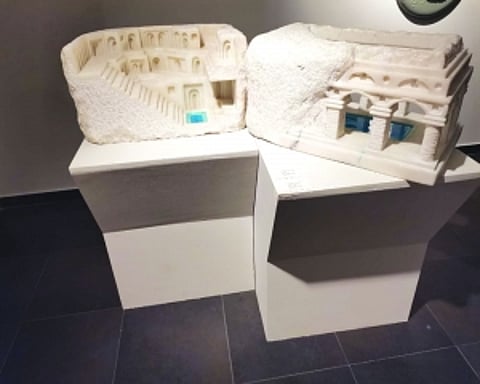
As I came across a fascinating marble sculpture showing an open haveli sort-of place with steps leading down to a bath, I had an urge to question the sculptor about the background of the same. Sangam explained, “My work is around stone-carving. I’ve been researching, for three years, on Champaner and Pavagadh heritage sites that have been disturbed. There used to be seven step-wells out of which only one is left now. It was known that the kings who went to war used to fill water from here (he pointed to the blue bath). Legend has it that whoever filled water from this step-well won the war. I have imagined how this must have looked like and created it, according to my data points and information.”
While when I saw the dozens of birds sculptured on the walls, I was particularly intrigued by the concept. On talking with the artist behind the work, Pinaki, he shared, “My work is made of recycled materials and some have been collected from the Chilika lake itself. There is an Odiya poetry conveying that Asian local bards leave a mark wherever they sit. That’s what I have literally attempted to show. It reflects the climate changes, their migration, food changes.”
Describing the vision behind the exhibition, Monica noted, “Art Centrix Space’s vision is to work towards the development of South Asian artistic practices through exchanges, programmes and curatorial interventions, to generate larger associations, and viewership of Indian contemporary art and work by local artists. Supporting young and mid-career artists has been an integral part of the aim and I sincerely hope the new expansion will encourage and provide them with the space they need. We all should hold hands and create an impact on the world, together.”
Here’s something for all the art enthusiasts — the exhibition will continue till December 11 at Art Centrix Space, Vasant Kunj.