
A group show of video installations by Khoj International Artists’ Association digs deeper into the anonymity and identity of cosmopolitan cities. By Team Viva
You are familiar with faces in your city but not with their names, even of your neighbours. The group show, Frozen World of the Familiar Stranger, deals with this growing unfamiliarity in metropolises and the resultant divide it causes. Parallely, the show also attempts to trace the similarities of life in two cosmopolitan cities, New Delhi and San Francisco, to drive home the theme further.
“Frozen World is based upon the uncanny sensation of the ultra-modern global megapolis and the increasing sense of alienation we encounter in our flattening world,” says Sitara Chawla, curator, Khoj studios. “It explores isolation, confinement, collapse, transience, anxieties and fantasies of inhabiting a collective urban space. Frozen World offers an almost satirical point of view on the human condition and what it means to be alive together in the present, and in the constructed future,” she adds.
Heidi Rabben, the co-curator of the show, says that the two extremities of New Delhi and San Francisco were chosen to show how similar life was in both despite disparate cultures. “The people in these cities influence politics and economic policies. There is a growing discomfort, feeling of anonymity and concern over identity among residents. Housing has become unaffordable for a majority in both. And there is similar tension and insecurity”, she says.
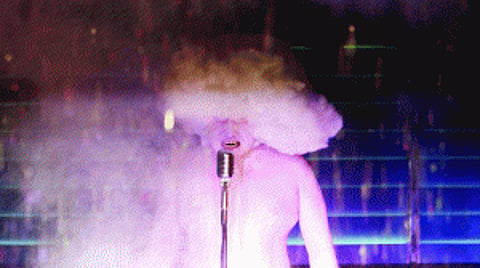
Artists from various countries have showcased their work in the exhibition, which was first held at Kadist, San Francisco. Chinese artist Cao Fei’s video work titled la Town places us in the midst of an envisaged, incipient, either recently past or impending catastrophe. Using tiny models, the artist creates a world suspended somewhere between reality and dystopia.
Keep your Stomach Empty; That you Mayest Behold Therein the light of Interior, by Iranian artist Farideh lashai, is a wall-based sound and projected animation on painting. Inspired by a 19th century painting by the legendary Iranian artist Sani-ol-Molk, the work symbolises a narrative of fear and of resistance, which are recurring themes in lashai’s work.
Indian artist Himali Singh Soin’s video work titled Radar level is set in the world’s last geological minutes in two ancient landscapes — one in the northern hemisphere in Mongolia and the other beneath Namibia. The background footage of it was shot in Mongolia on location where the first dinosaur egg was found.
Ho Tzu Nyen, based in Singapore, showcases a video work, The Cloud of Unknowing, that is titled after a 14th century mystical treatise on faith, where the cloud is paradoxically a metaphor for both an impediment to, and reconciliation with, the unknown or the divine experience.
Indian artist Kartik Sood displays a mixed-media work consisting of two videos, mixed media painting, and two sculptures in iron and clay titled Alone Among Many. It explores the character’s experience of loneliness in an urban environment.
Peruvian artist Maya Watanabe video work titled El Contorno questions the performance of a body in space. How much space does a body occupy or do spatial coordinates shape our movements and displacementsIJ
Rachel Rose from the US has a video work on display titled Sitting, Feeding, Sleeping. It takes us on a very particular journey through contemporary constructions created around different life forms, from medical breakthroughs in a cryogenics lab to basic scientific facts in a robotics perception lab, to animal care within zoos across the US.
Indian artist Sahej Rahal displays photographs that document performances titled Keeper and Katabasis. It was shot in Shodoshima, Japan, at the foothold of the Yoshida Dam, which holds a man-made “island” behind it. In Escaped lunatic, American artist Steffani Jemison’s video work, a steady stream of figures runs across the screen, sprinting, jumping and rolling through the streets of Houston.
The show concludes on January 11.