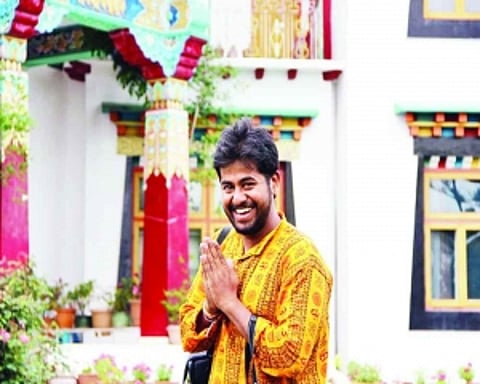

Filmmaker MSN Karthik’s film, Bodh Gaya: The Seat of Enlightenment, depicts our quest for peace and harmony, says Ayushi Sharma
Filmmaker MSN Karthik asks me if I knew something about vipassana? I didn’t. He explains that it is a meditative practice, which enables one to see things as they really are. It’s a way of transforming oneself through self-observation. It is this observation-based, self-exploratory journey to the common roots of mind and body that dissolves mental impurity, resulting in a balanced mind, full of love and compassion.
This is exactly what his recent film, Bodh Gaya: The Seat of Enlightenment aims to depict. A part of The Inner Path, a festival on Buddhist Film, Art and Philosophy, it revolves around the kind of transformation Buddhism can bring in people’s lives and the role it can play in today’s chaotic world.
As a part of his research, the film required that he read Buddhist literature and watch several decades-old documentaries on Buddhism. So did he personally experience the transformation that the practice can bring? Well, he says, “After completing the film, I went to one of the meditation retreat centres for vipassana in Nagarjuna Sagar in Andhra Pradesh. It happens for 12 days at a stretch where you are not allowed to talk to anyone, you don’t have phones, no networks and you just have to sit there and meditate for 12 hours everyday. You can’t even sleep at night because throughout the day you are sitting with your eyes closed. That was a life-changing experience for me as since childhood, I have never been away from my family and during those 12 days I had nobody but myself. It’s like a detox from the regular worldly affairs and gives you enough time to reflect upon your life. It’s more of an inward journey. I really cannot explain it in words because it’s very experiential,” he says.
Bodh Gaya captured his interest because of its rich cultural and historical significance. Every year more than two million people visit there from all across the globe and it’s also a UNESCO World Heritage Site. But most importantly he selected the place because he encountered Monlam Puja, a world healing prayer. He says, “It’s special because almost four to five thousand monks and practitioners from various countries come there at the time of puja. You can spot hundreds of them everywhere. I was very enchanted with the site. I thought if I have to film something, why not start from this sacred place. And that’s how it all started.”
His filming was divided into three different categories. First, he elaborates, “I spoke to the authorities of the temple, where I concentrated more on cultural significance of the place, the history of Buddhism and that of Buddha, how he got enlightenment under the Bodhi tree. Second, I spoke to almost 12 to 15 monks. I can recall one instance, where a monk, who was from the US, had left his country almost 20 years ago. He came to India and settled in Himachal Pradesh. He talked about his experience of adopting Buddhism, how it changed his life and the way he sees the world now. Third, it was discussion in terms of how and why they think that Buddhism can bring a change in this chaotic world. It was more of a philosophical thing. The film touches upon historical and cultural significance, the personal experiences and last, how Buddhism can bring a change in this world.”
Initially, Karthik’s goal was to make something on Bodh Gaya. He just wanted to capture the essence of the place and tell people what they can expect if they visit it. But his focus shifted towards capturing Buddism because of the paucity of the information on the place. “When I researched, I couldn’t find anything substantial on Bodh Gaya. There were some documentaries and standard information but they were just not sufficient to make a film from them. I didn’t have any strong direction point to take the film forward,” he says.
For many, films are a hobby. For some, they are a passion. But Karthik is the kind of person who always lived his life in 24 frames. Films were what shaped him since childhood. He says that he watched Robin Williams in awe, as he stood up on his desk to inspire his students to “seize the day”, in Dead Poets Society. Films seemed to be a powerful medium to communicate ideas and he wanted to become a filmmaker when he grew up. But he had to take up a software job after graduating from IIT. However, the filmmaking bug never died in him. He realised that storytelling was what defined him and that he would want to pursue it forever. So he started travelling across India in search of untold stories. From Bodh Gaya in the East to Rajasthan in the West and Himalayas in the North to Munnar in the South, he covered a lot of places and launched his first travel film series My Great Escape. Such a vast country seemed very small in front of his quest to tell an engaging story.
His latest film narrates the story of monks, who are seeking peace and harmony, because this is what we all lack in our lives. From time to time we all experience agitation, irritation, disharmony. And when we suffer from these miseries, we don’t keep them to ourselves, we often distribute them to others around us. Unhappiness permeates the atmosphere around someone who is miserable and those who come in contact with such a person are also affected. Certainly, this is not a desirable way to live.
And this is the sole reason why everybody visits Bodh Gaya, to find peace among all the chaos, Karthik tells us. “If you visit the place you’ll understand that there are people from various countries, who follow all kinds of religions and speak a variety of languages. You have Christians, Muslims, Sikhs and Hindus coming there. They all respect Buddha in the same way because they don’t see him as a god. He is a person, who showed the ‘Path of Enlightenment’. Everyone is following their own customs and praying in their own languages yet there is peace. Bodh Gaya, along with being religious, is a place for global peace and harmony,” says the filmmaker. Even the film depicts the same towards the end.
Ask him how these film festivals help directors like him to take such stories to the public? He says, “Today’s film scenario differs from what it was a decade ago when there was no YouTube and OTT platforms. I think, there is a specific role that film festivals play. While online platforms provide scale and take your content to the public, film festivals give you a lot of importance in terms of the contacts that you get. They give you recognition in the film fraternity because of which you start getting collaborators for your next projects. And you start growing.”