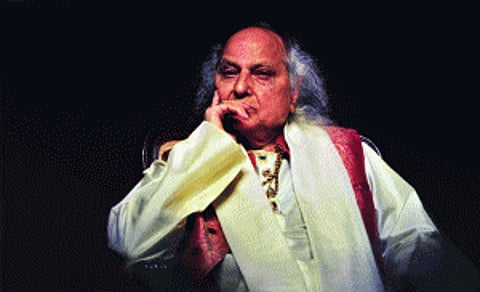

Pandit Jasraj is one of the few vocal exponents of Jodhpur’s Mewati gharana. He spoke to Shrabasti Mallik about the current state of Indian classical music, the changing definition of music and why he prefers to stay away from film compositions
Even at 84, Pandit Jasraj’s resonant voice held the audience in rapt attention. His health was failing him and he had trouble speaking but that did not deter him from rendering almost an hour of vocal recital. Not a strain of pain appeared on his face as his voice accompanied the tabla, harmonium and the mridangam. The reason he explained was that, “Music has the power to heal both the mind and the body. Aapko bas sangeet mein kho jana hai (You need to lose yourself in music).”
The octogenarian, who has been training in the traditional classical gharana ever since he could remember, feels that Indian classical music has seen a lot of change over the years. “I believe that whatever does not change is lifeless. Change is life. I’m an extremely positive person and I never live in negativity. However, one shouldn’t bring that change into oneself forcefully. They should embrace and respect it naturally as it comes. I don’t know what changes have come into my music; it’s for my audience to notice,” he said. He believes that classical music has moved ahead through the years. The maestro said, “The fact that it’s performed all over the world is a proof enough that classical music is alive — and any art which is alive is subject to change. That’s natural. Traditional classical music is moving forward, aesthetically and scientifically. like I always say, earlier classical music was like the Himalaya. But today it has taken the shape of a sea with rivers and tributaries.”
Born into a family of classical musicians (of the Mewati gharana) the vocalist forayed into music when he learnt to play tabla at the age of four. “But it was during my boyhood days that I realised that I was more inclined towards singing,” he said. He drew influences from stalwarts like Begum Akhtar and Amir Khan but later developed his own style. He ardently spoke about the gharana he belongs to and said that Mewati gharana gayaki has distinct qualities. “The gayaki is influenced by sufi and kirtankar. It includes theistic and spiritual elements, where religious verses from Hinduism and Shia Islam (especially Ismailism) are incorporated in the grammatical content of the music and is also an intrinsic element in musical development,” he pointed out. Mewati gayaki includes substantial use of sargam and tihais.
Such is his passion towards the art that the intrusion of modern technology in classical music does not bother him. On the contrary he feels that technology is a very helpful medium. He recalled, “When we were young, we found it very difficult to remember what improvisations we made on stage or what impromptu changes we made during our riyaaz. But, thanks to technology, today one can remember every note being sung — whether off stage or during a live performance.” He also does not feel that the growing popularity of fusion music, has in any way, hampered the pursuit of one-sided discipline. He said, “If someone is in love with classical music, they will never be swayed by the concept of fusion. It is all in the soul. Agar aapke zehen mein ek baar shashtriya sangeet bas gaya, to kuchh dooja nahi bhayega aapko (If classical music settles in your soul once then nothing else will interest you).” The artiste who has never tried stepping into fusion however mentioned that, “If my age today was 25 years, I probably would have done something like that.”
It is perhaps for this reason that the maestro has stayed away from Bollywood and commercial music. Apart from one single track Vaada Tumse Hain in the 2008 movie 1920, he has always remained rooted to his classical base. “I have never tried to indulge in Bollywood in the first place. I have taken a pledge that I won’t do anything which has nothing to do with classical music,” he said. The vocalist said that in his long journey he has never faced any monetary issues. He pointed out, “As far as monetary gains are concerned, I have survived with just Rs25 and hence it is not everything to me. My wife is V Shantaram’s daughter and I could have done a lot of things if wanted to; but I didn’t. Whatever I do, I am satisfied.”
The artiste was in the city to receive the Sumitra Charat Ram award for lifetime achievement. Panditji was overwhelmed to receive the honour and said, “It is my privilege to be awarded for lifetime achievement on Sumitraji’s birth centenary. For an artiste, every award is important. I know how much she has done for music. She has patronised a lot of musicians in her lifetime. And it is not that she had inherited it; she started everything from scratch.” He also mentioned that although he never meet the art patron in person, her foundation Shriram Bharatiya Kala Kendra will continue to produce the best in Indian classical music scene for years to come.
photos Sanjeev Kumar