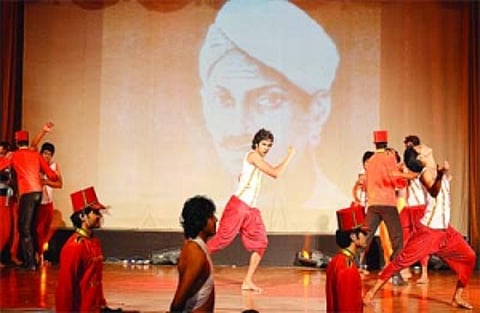

Santosh Nair’s Jashn-e-Azadi presented India’s liberation movement and its aftermath. Utpal K Banerjee reports
It is quite appropriate to celebrate the blossoming of nationhood in 1947; the chime of the midnight-clock to announce a new awakening, when the rest of the world was still (metaphorically) asleep; to remember the 190-year-old freedom struggle since 1857; to pay homage to the multitude of martyrs who could have said: “When you go home, tell them that for their better tomorrow, we have given our today.”
With those birth-pangs, did two Indias emergeIJ The first Premier Nehru hailed the first India, when he called Bhakra-Nangal Dam “new temple of India”, with many more dams and reservoirs, science laboratories, large industries and technology parks to come in its wake. This India had an urban frill, with mushrooming airlines winging into the national air, household telephones becoming useless with the invasion of mobiles everywhere; countless cars cluttering every cityscape.
On the countryside, nascent agro-revolution ensured the produce of wonder seeds and bumper harvest of fruits. But perhaps a second India lurked behind and below — which was born lacerating with ghostly trains, loaded with butchered bodies, crossing over the newly-formed landmasses and millions of refugees migrating across the still-unmarked borders.
Their hapless progeny today comprises the farmers committing suicide to get out of deadly shackles of debt, women inflicted sexual assault, the caste-ridden society gloating over “honour killing,” gentle folks relieving and defecating in the open as a rule rather than as exception and the unborn female foetus in mother’s womb wailing against the cruel tongs of abortion. If there are two Indias, shall the twain meetIJ Or is it a chimeraIJ
Jashn-e-Azadi, recently presented by Sadhya and organised by Nehru Bal Sangh, was showcased as an unalloyed excitement on India’s liberation movement and its aftermath, sans any unpleasantness.
Under the competent baton of Santosh Nair, and full of verve and vigour, the young band of performers began with figure-gymnastics and aerial acrobatics, to the tune of lata Mangeshkar’s lilting Vande Mataram... traipsing with Daal Daal Par Chidya Naache... dancers transformed themselves into Sepoy-Mutiny soldiers, with Mangal Pandey executed and Mangal Mangal… danced to a virile jham dance-style. The ruthless British occupation came up with uniformed Jackies and the heroics of Jhansi ki Rani followed, with the brave queen done in.
Then came vigorous choreographies with Sarfaroshi Ki Tamanna and Aye Watan Aye Watan interspersed with full-throated calls, Inqilab Zindabad.
There were full screen projections on the cyclorama, whipping up the audience enthusiasm, as was proved by the vivid gallows for Bhagat Singh alongside his fellow patriots or the execution of the 18-year-old Khudiram — who smiled all the way — or the crimson of blood and gore for the lyric, Khoon Chale Khoon Chale… Gandhi ji’s arrival on the scene in 1915 was briefly highlighted, moving directly into 1947 and Nehru’s stirring speech in the Parliament. Satyameva Jayate was sung a la Aamir Khan, leading to a great lyric by Hariharan: Bharat Humko Jaan Se Pyaraa Hai. After another song, Kandho Se Kandhe came the tumultuous finale with Rehman’s memorable rendering of Vande Mataram.
Santosh said, “Independence is a moment of pride and glory for every Indian. It’s like a festival which should be celebrated with much more gusto. With an aim to instill in oneself the various emotions — reflecting the journey from peace and serenity of our golden age, through the pain and humiliation of suppression, to the passion for independence and the enthusiasm for progress of the present — we presented Jashn-e-Azadi.”
He justified the raison d’etre of the programme, “The idea behind the production was to celebrate the spirit of freedom. It was also to emphasise the need to strongly pay attention to the fact that with freedom come the roots of responsibility.”
For once, there was no sorrow mentioned, and the second, fractured, down-and-under India was pushed aside, for the noble cause of celebration.