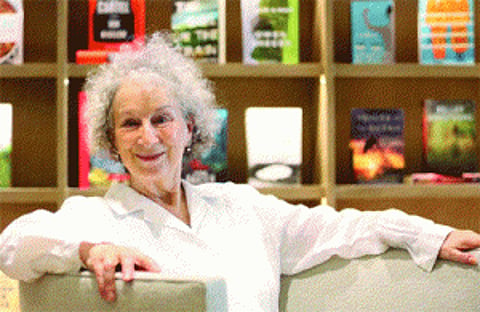

In a heartfelt conversation at the Jaipur literature Festival, author and poetess Margaret Atwood explained to Riya Sharma that if one has insecurities while writing a book, one should use a pseudo name
Anticipated, we sat in a verandah of Diggi Place waiting to meet the author we have been reading since we opted for a course, as budding intellectuals, in English honours. Many thoughts crossed our mind — should we ask about her latest book, The Heart Goes last, or about the poems that we read in the courseIJ Dramatic as it may sound, but for the first time in our life we could hear our heartbeat in a place full of people and all sorts of different sounds.
Stooped a bit, the author of This Is a Photograph of Me, Margaret Atwood, came in person, as if right out of the pages of our college textbooks. In her low voice, she said, “let me finish this, and I will get back to you (pointing to her publisher).” Starting with customary greetings, she continued, “You need to listen to the publisher or they won’t call you next time.”
She initiated the conversation, “So you have studied journalismIJ Was it funIJ Or being a journalist is more funIJ” When we gave a reply in affirmation, she immediately replied, “Because you don't have to pass an exam.” (laughs)
She started with her latest speculative fiction, The Heart Goes last (published by Bloomsbury) which presents a Dystopian view. “In the19th century, there were a lot of Utopians. But then, came the First World War and we discovered steam engines and bicycles,” she started laughing. “Then everyone thought it was going to get better and better, but it did not. The other reason why young people are reading and writing about the Dystopian is because they are worried about the future and about what is going to happen if global warming is going to get more prominent. So we are getting a lot of this kind of fiction, but I don’t know how long this trend will continue,” the blue-eyed author commented.
During one of her sessions, Atwood had said that writing is an optimistic experience. But how does she compare that with a Dystopian viewIJ “The act of writing is optimistic but the content is not,” she said and stopped for a moment to choose her words. “First you think you can write a novel — very optimistic. Second, you think you are going to finish your novel and that is optimistic, too. Next, you think that someone will publish it, and once it is published you think someone will read it — that is more optimistic. And when people like it, then think of the optimism that is involved,” she laughed and continued, “The most optimistic thing is, that you believe that human communication is possible. Any writer is pre-supposing a future reader even when they are writing their secret diaries. This is the reason why we find prison memoirs because people assume that there will be readers. That is another optimist — where we have a person writing in extreme circumstances thinking that communication is still possible.”
Her readers have always loved her novels narrated from a women’s perspective. But when she wrote a novel — Oryx and Crake from a man’s perspective — they loved it, too. “My women characters range from really horrible to fairly ordinary. None of them are out of hunger games. They are so varied that you cannot really say whether they are old, young, bad, awful or stupid. Similarly with men. As soon as I wrote a novel from a man’s perspective, people asked me why I wrote it that wayIJ You have to take a closer look at the characters. How do we look at the characters in a bookIJ A character is defined by what they see, what they think and how they are treated by other people. And that is how we look at people in real life — how do they look, how they dress and what shoes they are wearing. A lot can be learnt from that,” she explained.
During the course of the interaction, she added that she never answers a question when someone asks her whether or not she is a feminist. “I never answer the question when people ask me if I am feminist unless they tell me what they mean by that word. It holds different meaning to different people. Do we mean, a mean girl who will push all the boys off the roofIJ Then no, I am not a feminist. Do we mean someone who believes that women are human beingsIJ Then I will put up my hand (actually putting up her hand) and will give my vote to giving equal access. And that will give women equal opportunity. You should have equality under the law,” she said.
Giving a piece of advice to the young and budding authors she said that there are chances that one may not become popular. “If you have a lot of fears and insecurities then you should write under a pseudo name, it will give you a lot of freedom. People can practice without the adverse effects that publishing can get at times. When I was a teenager, the closest thing I knew of publishing was the school Year Book. You do learn a lot from your failure. So if you don’t succeed, fail again,” she wrapped up.