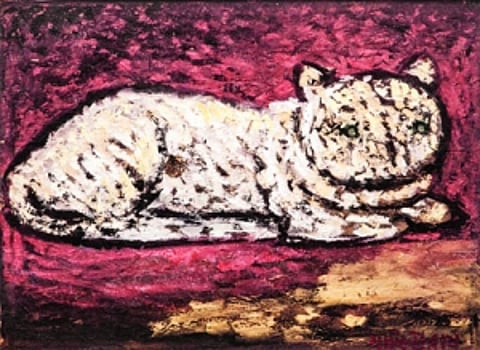

Akar Prakar’s forthcoming exhibition will show Jamini Roy’s rare works. Curator Reena lath tells Karan Bhardwaj how the rebellious artist penned a new chapter in the world of art
What are the key highlights of the exhibitionIJ
The highlights are inclusion of Jamini Roy’s works from the earliest phase where he used oil on canvas to later when he moved to traditional tempera or gouache and used ordinary indigenous material of the village craftsmen. There are paintings after his adoption of folk idiom where he painted monochromatic calligraphic works where one can easily see the influence of the Kalighat paintings and his later period works.
Jamini’s works are quite modern yet rustic and rural. How do you think they fit the bill todayIJ
The artist possessed a strong sense of individuality in his art and life. He stood up for the change that India was looking for at that time and, there was a need for an “Indian approach to style”, this revolt and standing up for an individual style, despite public oppositions, makes him a hero for all younger generations.
Jamini’s works put forth the rural India, people’s happiness and joy. Tell us more about the body of his work, inspirations and philosophies.
Here I would like to quote excerpts from Jamini Roy: His life in Art by Sandip Sarkar. Roy’s greatest credit has been that he really challenged the rearguard action of remnants of the Neo-Indian school stubbornly defending the studied archaism. By his campaigns, he defeated them. This he did by relying on the vigour and vitality of folk art. Folk art was his source, as Picasso’s was primitive African and Iberian Art, Matisse’s was Persian art, the Impressionists’ including Van Gogh’s was Japanese landscape and Henry Moore’s was pre-Columbian American art. Part of the misunderstanding about Jamini stems from our not conceding that he was a modern artist steeped in the Western tradition. That he happened to be an Indian added to his and our confusion. He belonged to the modern trend of referring to non-Western sources of human art, the more primitive or naïve the better.
Jamini was rebellious. He rejected the prevailing ideas of art and even walked out from art school run by the Britishers. Can you tell us more about how he discovered his own styleIJ
He’s considered one of the pillars of modern Indian art as he found a new language of modern art. It was in 1921, when he was 34, that he gave up working with oils on canvas, renounced his sophisticated style which he acquired through his training as an artist, under the British rule and began using Indian motifs and materials from his observations of folk artists and craftsmen, from his childhood, spent in Bankura district of West Bengal.
How did he delve into subjectsIJ
He struggled to establish a name and place for himself after giving up a lucrative practice of portrait making to reinventing his art, by going back to his roots, the local materials, the folklore, Santhal women, toys, that he grew up seeing during his growing up years in Bankura disrtict.
Roy used many themes for his artworks and often repeated them in his studio. There was no specific theme that made him more known.
His favourite subjects were the Santhal women, the gopini, scenes from Krishna’s life, village people, mother and child to name a few. Some of these works can be viewed at this exhibition. What was exclusive and remarkable about his work was the peace he had made with himself and with the world. Flat, bright figures painted in the conventional forms of Bengali artisans revealing his reverence for the dignity of India and Hindu lore. He grounded his own colours and composed his drawings with simple economical lampblack lines, all expressing his belief in his art.