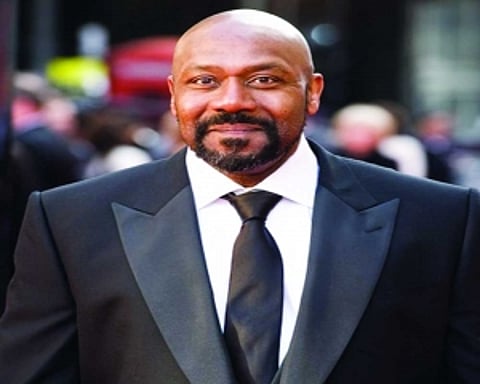

Lenny Henry, who plays Godfrey in The Long Song, says that it shows how slaves of Jamaica utilised humour just to get through the day, which is what gives the audience an alternate side of looking at slavery. By Team Viva
How would you describe The Long Song?
It is an adaptation of an Andrea Levy book, which centres on the pre-abolition Jamaica, which was quite a rebellious island, having two or three rebellion movements every year during slavery. It was a very pugnacious island. Andre’s book centres on a plantation called Amity, which is probably fictional, where the slaves are just catching on to the fact that there’s freedom but in reality, there’s just the whiff of it. Some of them are sceptical.
My character, Godfrey, is the head of slaves. He is sceptical because they’ve had trouble before and nothing has come of it. But this time, it might come to fruition. And Caroline Mortimer (played by Hayley Atwell), the lady of the house, is slightly incognisant of the fact that change is coming. She has adopted a girl called July, whom she clings on to as she is the only one who can help her communicate with the slaves.
Godfrey is very proud being the head of the slaves but then he sees that freedom is coming and he’s on possibly the wrong side and he must take action.
What does this story mean to you?
My family is from Jamaica. Hence, I don’t do ‘who do you think you are’ because all the two to three generations have been full of slavery. So it’s in my family.
I did a documentary called Caribbean Kid recently, and we went back to my grandmother’s house, which was at a plantation island. We went inside her house at the back and there were all these slave graves — small ones for babies, big ones for adults. That’s how slaves were buried — on the property. So when I read The Long Song, I felt that it’s an alternate slave narrative in which Andrea is saying that at some point, slaves would have utilised humour to just get through the day. And I really believe that. It wouldn’t have been weeps every day. There would have been some moments where there was laughter.
So Andrea has drawn a razor-thin line between the drama of it and where we are allowed to know that slaves had a sense of humour. In this drama, you’ll see other sides of what slavery was like too. It’s interesting, very much like the status quo. The given circumstances were that slavery existed, people had and were slaves, but they still had to behave as human beings throughout. There’s no moustache twirling in it, which is what I like about it. Yes, some people were heavy-handed but there were people who were just human beings and were toxically affected by what they were doing to make their money.
You know about this world from your ancestry but do you think it’s been represented on TV this way before?
I think it’s the time to see it. We have seen a great change recently in terms of represented on screen and telling stories. So with the kind of good content coming up, people also want to watch and know about such chapters and people of history. We have heard a lot of stories about slavery like Belle, 12 Years a Slave, Django, but this is important because it presents an alternate perspective on it. There’s a zeitgeist in the air to tell stories about slavery but I think gatekeepers who are in charge of what we watch get a bit frightened, thinking ‘is this fine?’ But we say, show it, it’s important for people to know.
I wasn’t taught this stuff at my school. So I think it’s important for young people to know what had happened. If you don’t know your history, you can’t predict your future. People mustn’t be allowed to sweep these things under the carpet. These are the stories that must be told. After you’ve watched something like this, you won’t be able to say you didn’t know, anymore.
Can you tell us who you play and what your way into him was?
It’s interesting being an actor now. I used to be a comedian and I was only concerned if things were funny or not. Now being an actor, you’re more concerned with if things were true or not. Depending on who’s directing you, sometimes, it’s heightened or more naturalistic, but generally, you’re trying to represent something truthful.
My character, Godfrey, who is the head slave at the Amity plantation in Jamaica, is described in the book as a man who’s past the age of being strong, or maybe, ‘a man’ or a lion. But he’s still a proud being. He runs things. It took me some time to get to where he’s coming from. And I kept thinking about my father actually, who came to Britain in the 1950s and worked really hard. He wore his pyjamas under his clothes because it was too cold. Very austere person, he had a sense of humour but quite a lot of schadenfreude with it. He would laugh if something went wrong. For instance, someone slipping over in the snow might make him laugh but he wouldn’t laugh at Frank Spencer on TV. He had this quite severe turn to his mouth. He would tease but you would barely know you were being teased until you saw a flicker of something in his eyes. So there’s a lot of that in Godfrey. He’s got a sense of humour but he keeps it very firmly entrenched. He challenges Caroline Mortimer and teases her but she doesn’t know she’s being teased. There’s a fantastic turning point, which I won’t reveal, because once he realises there’s a possibility of freedom, he does realise that he’s been slaving all these years and treating it as a career.
He has to make some decisions about what kind of a person he wants to be and I think that’s a fantastic story arc. A character who is entrenched in slavery, has been strangely mind-warped into believing that this is a good thing to be doing — bossing the other slaves around, throwing his weight, thinking he’s the boss — but not being paid for it properly (because he’s got a wife and family to take care of), he is also a slave. Then suddenly, he realises there’s only this whiff of freedom. ‘What would I do if I got freedom? Would I stay at Amity? Would I leave? Would I continue this job? Is this a career or is this slavery? It’s slavery!’ It all unfolds for him later. He teaches July about surviving. Very subtly, but he’s keeping an eye out for her as there’s a fatherly aspect to his character. He has a very sly, deadpan wit.
Has there been a particular scene or a moment when filming that meant something to you or transported you back?
I think the scene when Caroline is making huge plans for a Christmas party and Godfrey is patiently trying to explain her that she doesn’t have the money to afford all these grand plans and it all explodes. But there are a few moments when he is teasing her and all his colleagues can see that but she can’t. Suddenly, it becomes very apparent and she explodes.
In that scene, you get a very strong sense of the line — Godfrey is behind the line — but there are moments when he creeps up to the line, having to hold in the laughter. And when he crosses it, there’s an explosion. I think in all areas — whether you’re in jail, a concentration camp, in slavery — any of those restrictive and constraining places, there are those people who push it ahead. Godfrey does that too. He tries really hard. Well, it takes a lot of bravery and guts to be that person.
Did you meet Andrea?
I was very lucky to be allowed to be into Andrea’s preparation when she was writing something as a part of another project that we were discussing together. It meant we got to speak a lot and we got to be friends. At the time, she told me to read The Long Song and I now see why she did because Godfrey was in there.
What is the appeal of The Long Song?
I’d say it’s Andrea Levy. She should be like the British kitemark (a UK product and service quality trade mark) for standard. Fantastic writer of a fantastic story. And an alternate perspective to the slave experience that you perhaps haven’t seen before. This is an iconic and fascinating story that utilises humour to say tough things. And I don’t think that we have seen that before. I think we have only seen the very serious, dramatic and shocking experiences of those who lived the life of a slave. But we have never seen all that undercut by a sly sense of humour, with an unreliable narrator. We’ve never had that.
And I think Tamara does such a good job of playing July with a deftness of touch. There is no sledgehammer stuff going on here. It’s rather very delicate and light. There’s humour when there needs to be humour. There’s silliness. But it doesn’t flinch from the truth of what was going on. And I think that’s why you should watch it because here, you will not only find something that you can watch and enjoy but you also say, ‘Oh my god, that happened.’
(The Long Song airs every Monday at 10 pm on AXN.)