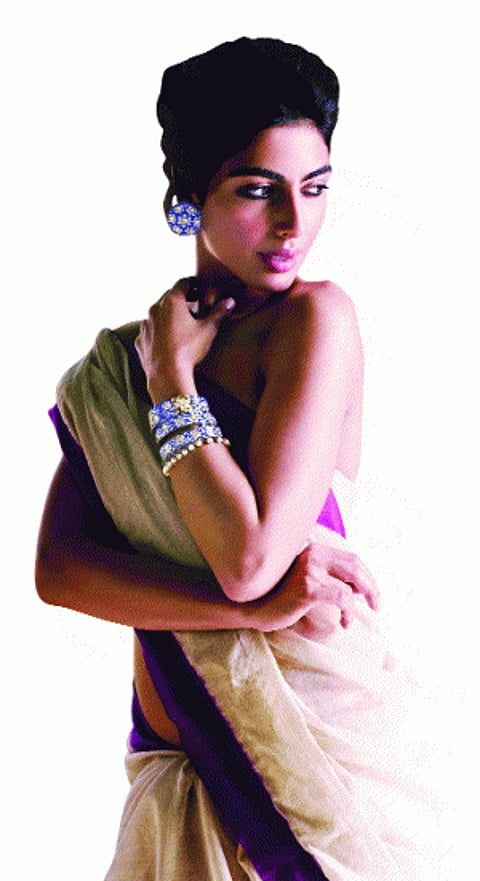

Royal jewellery designer Sunita Shekhawat says there’s nothing that can match the luxury and unique beauty of hand skills. Ankita Jain reports
With the backdrop of a hand-engraved wall installation of Amer fort, the new flagship store of Sunita Shekhawat is warm and welcoming with bright yellow lights and sweet scents. The space presents heritage fine jewellery in a gallery format that exudes the charm and culture of Rajasthan. One of her exclusive pendants and cuffs from the firoza collection is seen the moment one enters the store. The signature pieces showcased burst with colours and ripple with life, as her delicate enamel work weaves its magic around rose-cut diamonds, pearls and other precious stones. Besides jewellery, the artisans are also at play, having come all the way from the atelier in Jaipur, working their intricate mesh of expertise on delicate and sparkling golden wires.
Renowned for traditional meenakari work, Sunita’s eponymous jewellery brand has a royal history. In 1994, the boutique store was inaugurated by Her Highness the late Rajmata Gayatri Devi, and over the years, has catered to almost all the royal families of India and the Middle East. Her access to the exclusive grammar of handcrafted jewellery serves as a constant inspiration for designs.
Initially based out of Jaipur, this 23-year-old venture has slowly expanded its business across India. Born in a Rajput family from Osian thikana, Sunita has been known for the purity of gold in her work and her reversible pieces. Draped in a pink silk saree with lotus motif on the border matched with one of her statement pieces, the founder of the signature boutique store herself turns narrator. “Jewellery is a subject that has always fascinated me since my childhood. I was always thrilled by their unique motifs and designs, each item a boutique piece of concept and imagination. Being royal estate managers and chiefs of principalities, my forefathers had links with the royals of Jodhpur. That’s how I got to see their beautifully hand-crafted jewellery which otherwise is not accessible to others. And my extensive travels as the daughter of an Army officer inspired me to draw inspiration from local traditions and create designer pieces of my own.”
Dealing exclusively in kundan-meena jewellery, each of her statement pieces passes through many hands as it is sculpted, painted and engraved. “Kundan is in heavy demand by brides these days,” she says and adds, “The prices are from Rs 1 lakh onwards. Kundan is preferred more than gold due to high wastage and low resale value of gold. Kundan pieces are often too grandiose to be donned on simple occasions and can be later deconstructed and re-designed into smaller accessories.”
Throwing light upon the struggles she faced in the beginning, Sunita says, “Most Rajput women of my time were restricted to domestic life but I firmly decided to realise my dreams. Obviously, the beginning was not a rosy one at all, not praised either as I took on a male-dominated business. But I was confident about my skills and had a nose for what women wanted. I believe that nothing that is easily achievable is ever worth achieving.”
She also explains why she chose kundan and meenakari. “Way before the standard proportions of a brilliant cut diamond were decided upon, and even before the shape of a diamond itself was defined, craftsmen cut the beautiful raw diamonds in whatever shape was desired by the design of the final product. In those days, diamonds and other ‘uncut’ stones were set in the only form of setting that the craftsmen knew. Very fine, hand-beaten sheets of pure gold sheets were hammered together in the form of cups or holders or containers to prop up the diamond. Each ‘cup’ was filled with a natural glue like blackish coloured substance called lac. This was then covered by a very fine film of pure silver which was used simply to cover the lac and bounce off the shine of the diamond like a reflector. The diamond was then pressed in the lac and the edges of the cup were gently pressed on to the edges to secure the stone in place. Once the lac dried up, it would harden thus holding the stone in place. To give a well groomed finish, the reverse side of the products was beautifully decorated by an engraving technique called meenakari.”
Recognised as an upholder of the legacy of meenakari, Sunita explains, “My artisans and even their children are trained in this field. It was not because they had to but because they wanted to. Moreover, there are other people also who do not come from the jewellery background but are tremendous at their work. I believe that there is no word called legacy. Jewellery-making is an artform and can be learnt by anyone. If I can master this field, anyone else can also do the same. All it requires is the will to learn.” Talking about her daughter, who is also into jewellery designing, Sunita says, “She is the creative director of the company. She has learnt because of her surroundings she has grown up in. She will be starting her own line soon. These days I take her advice regarding my designs but poor girl, she has never been credited for the work till date.”
Talking about her design aesthetic, she elaborates, “The point is we like to appeal to those wishing to strike a balance between tradition and modernity. My pieces can be teamed with jeans and shirts or ethnic attire. Our clients are our teachers. We value feedback; it takes us a step further towards achieving our goal.”
Asked about a collection which is close to her heart, she gushes, “Coming from the pink city, I am fond of this colour and many of my collections play around this monotone.” One can see her love for pink through her sari as well. “Neelpushpa and Neelkamal are two of my favourite collections, the former a fusion of royal Rajasthani lineage with Turkish art. The collection has typical blue pottery colours with motifs inspired from frescoes and murals of the heritage havelis of Rajasthan and the interior panels of the Blue Mosque in Turkey. Neelkamal is a concept of the pure hand-drawn detailed jewellery with lotus petals and leaves in shades of the soft pink and white. Also, both the collections have eclectic stone artwork.”
Design is not just an art form for Sunita. “It goes beyond being just a canvas for my creativity. It becomes a medium for my story-telling. These pieces are also a representation of my personal journey as they retain the best of everything I see in the world around me,” says Sunita who would be an interior designer if not a jewellery designer. It takes her around 90 days to complete a single collection. Sharing her connections with the artisans, she smiles, “My craftsmen are really fond of me. We are like family. All the family issues are discussed between us. My day never ends without talking to them. Till date we have the same artisans who used to work for the royalty. And there’s nothing that can match the luxury and unique beauty of hand skills. This is a 250-year-old art which we are blending with modern demands.” Describing the Sunita Shekhawat bride, she says, “Someone who understands art and culture, as our designs have a lot of cultural adaptation. She likes classic yet timeless jewellery with a touch of modernity.”
Any tips for the 2017 lookbookIJ “Head accessories will steal the show this season — head cages, head bands, etc, which are extremely design centric. Jewellery, in general, should evoke both classic and contemporary charm,”