
Hybrid cars are expected to replace petrol vehicles in a decade in several nations. The Indian market, too, is charging up as Hyundai, BMW and Nissan launched their electric automobiles at the ongoing expo, says Karan Bhardwaj
Sachin Tendulkar’s presence might have created a frenzy on the opening day of Auto Expo but experts looked beyond glamour. For many, it was definitely not the only reason to visit BMW’s pavilion. The prestigious automaker’s launch of its i8 hybrid car added to the excitement around hybrid cars. If experts are to be believed, these electric cars would soon replace the petrol-driven vehicles.
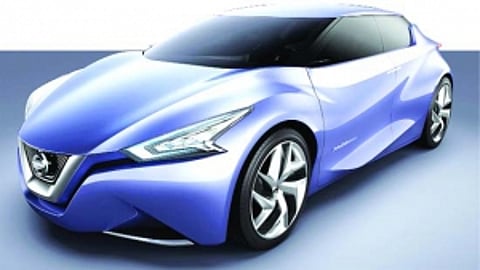
Major giants like Hyundai, BMW, Nissan and others are showing keen interest in this emerging market. Take Nissan’s Friends Me. Stylishly crafted, a new hybrid concept car displays stylised lines, a departure from Nissan’s usually clean geometry.
The front end wears a deep set V-shaped grille that has the backlit Nissan badge in the centre. The lED headlamps show a boomerang shaped lighting signature. The concept which has already impressed market is Hyundai’s Santa Fe Blue Hybrid. Its powertrain is 2.4-liter Theta four-cylinder engine coupled to a six-speed automatic with the addition of a 30kW electric motor.
DYPDC Center For Automotive Research & Studies also launched its green vehicle EM4. It is a fuel cell electric vehicle powered by hydrogen and produces zero exhaust emissions. “DYPDC and our group decided to manufacture a concept hybrid car in our first meeting itself,” informed Chima, head of School for Engineering, Birmingham University, UK, who has spearheaded the mechanical part of the car. According to the engineer, hybrid cars may have a small market at the moment but have a huge potential. “In the last couple of years, things have changed drastically. I believe that in the next 10 years, hybrid cars are going to take over petrol vehicles in a few developed nations,” he said.
The EM4 is expected to carry five passengers at speed of up to 80 km/hour with an estimated empty range of around 150 kms. “The vehicle is pollution and noise free. What comes out of it is a few drops of water every 10 minutes which can be recycled also,” said Chima.
The Auto Expo is also hosting a pavilion dedicated to electric vehicles. The exhibits include Maruti Suzuki Swift RE, Toyota Kirloskar Camry Hybrid, Tata Motor’s Iris and Magic, TVS Motors E-Scooter and
E-3Ws, Hero Eco E-Scooter, Mahindra & Mahindra E2O and Maxximo. “As a result of growing GDP, India’s primary energy consumption is expected to increase by 70 per cent in the next 10 years. The gap between domestic crude oil production and consumption is widening, leading to increase in imports and consequent impact on the trade deficit. Thus, we want to create awareness among consumers,” said Vinod Dasari, vice president of SIAM. Visitors can also take test drives which will “allow consumers to have a real life feel of these technology vehicles.”
Though hybrid cars hold promising future, there is an array of challenges. Viability, public perception and infrastructure are on the flip side. Dependence on batteries and charging point is another issue. “But that is gradually changing. Initially, people were skeptical about CNG also but it went on to become a huge success. As far as the infrastructure is concerned, India has a long way to go. But these requirements are much simpler if you have the right technology. India needs to develop the hydrides for hydrogen,” Chima said.