
While he paints, images and colours are the immediate realities. Akhilesh Verma explains how abstraction is the ultimate goal. By Team Viva
He is always at a loss for words in front of an art work or the sound of music. The world around may have transformed, but certain things remain the same for him. He too is often racked with anxieties of being alone of loss and death. But art gives him hope.
For 10 years the artist worked with the single color — Black. Akhilesh used different surface colors on which he used the single colour black to bring out his expressions. Through this the artist was trying to understand the tonality of the color. Artist Akhilesh Verma, who turned 60 recently, is celebrating it with an exhibition titled The Past WasYesterday.
In the work Beyond that Ink on Paper, the artist has worked with black only, then he began to use the paper brown and with this he introduced a second colour in his works. In Where to go Ink is a work on Bitumen paper and it is used here as a fragile waterproof, which is difficult to work on, but the texture attained in the end is worth working on. lyrics Gouache on paper, created with colour mixed with water is not transparent but opaque. The paper here is black and on that red gouache colour is used.
The show, at Aakriti Art Gallery, consists of 62 works including paintings and drawings and sculptures which were created by the artists between 1974 till 2015. To him abstraction itself was the medium and the goal. “My journey as an artist went through different phases and it was after many experimentation that I found my oeuvre. I found deeply affected by colours around me, the bougainvillaea blazed a gaudy magenta and skies were bright blue. I was surrounded and obsessed by colours. Seeing Raza’s exhibition I was more convinced that Indian colours had to be a part of my narrative,” the artist says.
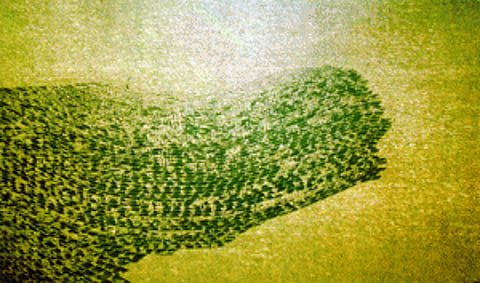
His paintings do not scream for attention and have little to offer to the casual, hurried viewer. “At a glance, my paintings appear to tread the mid path between figurative and abstract as; one tries to understand the several possible forms that emerge from the mosaic of patterns. I want to encourage onlookers to relate to the works by having a dialogue with colours, forms and textures,” he says.
Based in Bhopal, the artist’s career spans over forty years. I came to Bhopal in 1982 when Bharat Bhavan had first opened its doors. I found the city fascinating; the undulating landscapes, the vast lakes and the eccentricities of the people. When I resigned from Bharat Bhavan friends in Delhi and Mumbai asked me to come and settle down there but the slow pace of the town was something I had grown accustomed to and was reluctant to leave. life could wait,” he chuckles.
His favourite poet is Rumi, whose influence could be find in some of the works. “Around you there a change in the way people think, feel and behave. I am reminded of the Kashmiri poet Agha Shahid Ali’s words: “I had still not learned the style of nomad — to walk between the rain drops to keep dry”, says the artist who is an author as well.
“While I paint, the images and colour before me are my immediate realities and my fantasies come to life. Momentarily the world outside fades away, the stentorian choices of the television anchors predicting doomsday recedes. In its place, the magnificent strains of Pandit Kumar Gandharva fill my room and as the musician’s voice ebbs and soars, I sing as long as I paint,” he says. The show concludes today.