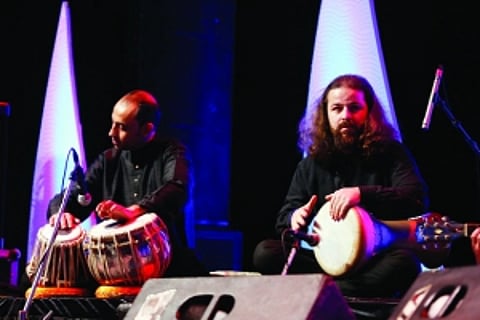

lead singer and composer Fakhroddin Ghaffari of The World Ethnic Music Ensemble spoke to K Dua about their unique melodies inspired from folk and classical artforms
An Iranian musician calls Delhi his second home. A cellist from Hawaii has studied Islamic music traditions. Two Indians play the sitar and the tabla. But their collective power rises above borders as was witnessed through their soulful melodies at the Sacred Pushkar festival, it was supported by Shree Cement. All were united by their sheer passion representing varied shades of classical traditions across the globe.
Their music aspires to break the shackles of nationality as each one of them comes from diverse musical and cultural traditions. Fakhroddin Ghaffari emphasised, “We hope that the notes we compose does justice to whichever musical traditions it is inspired from.”
The band has performed in different parts of Rajasthan including Nagaur, Jodhpur and Jaipur. This was their debut act in Pushkar.
He said, “I have fallen in love with this city, it’s so scenic and pious. For our kind of music, we expect a quiet listening audience and they were indeed quiet patient and appreciated us. The response was positive and quiet overwhelming.”
He added that their music is composed for the purpose of creating art and their vision is to not view it solely as a “medium of entertainment but to connect with passionate minds.” Ghaffari has around 23 years of experience in percussion.
Ghaffari is an Iranian musician from Kurdistan (25 per cent Turkish and 75 per cent Kurdish) who calls Delhi his second home. “I moved here with my family when I was 15. I grew up imbibing an artistic culture as my family is filled with artists, musicians, painters, calligraphy artists.” So, art runs in his genes.
The World Ethnic Music Ensemble (WEME) was formed in 2009, comprising Ghaffari on tonbak; Fateh Ali Khan from India on sitar; Sultan Masood from Afghanistan on violin; loic Sanlaville from France on guitar; William Rees from UK on the Afghan Rubab; Nawahineokala’i lanzilotti from USA on cello and Mohit lal from India on tabla.
The band has been constantly evolving. Ghaffari usually composes on sitar and has been learning Indian and Persian classical music since a long time now.
“As a band we take folk melodies and modify them taking inspiration from classical forms of India, Iran and various other countries. For instance, one of our compositions is called Greek as it’s a melody from Greece that we have shaped according to our sensibilities. We have recomposed and restructured Greek — changed its rhythm while retaining its core.”
The band members possess a diverse set of skills that was depicted in their versatile performance and experimental style. lanzilotti is a cellist from Hawaii who has studied Islamic music and plays Hawaiian music. She and Masood are inclined towards Indian classical. Masood is a skilled western violinist while Sanlaville is a jazz guitarist, learning tabla. Rees is adept at playing rubab and sarod. According to Ghaffari, Ustad Fateh Ali Khan is one of the finest sitar players and lal creates magic with tabla.
“The rehearsals are limitless creating spaces for all of us. It’s like a canvas where we are all sitting around painting it with sounds.”
They have performed in an array of musical festivals including Contemporary Arts Week, Arman Festival (organised by Iranian cultural house), Delhi International Art Festival (DIAF), Hampi Utsav and so on.