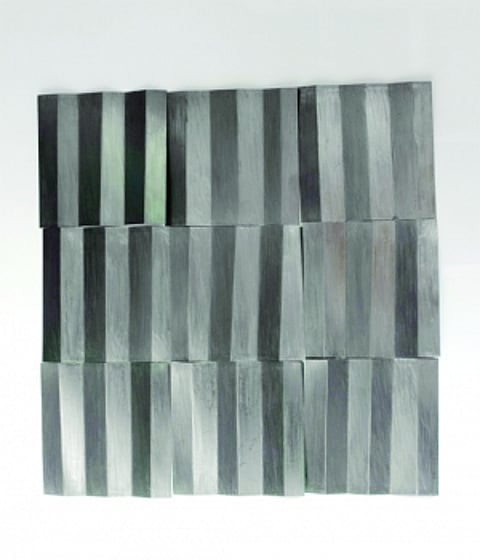

Ayesha Sultana's present body of work gives an insight into her research on space and different drawing techniques
Rooted in process and the act of making, Ayesha Sultana’s first solo exhibition provides an insight into her ongoing investigation of drawing, of seeing space in continuum, of exploring gaps in visual memory and of looking at the periphery and what is overlooked in plain sight.
The artist doesn’t restrict herself to one medium. She explores different techniques, but she focusses on the features of materials she uses for her art works. Having discarded the narrative, she often uses drawing as a verb, of ‘doing’ whether by cutting, folding, piercing, layering, recording, tracing, removing, scratching and so on.
Some works in the exhibition, made by photocopying for instance, are an extension of that process of investigation, taking its initial source from photography and later enlarging and creating multiple copies of the same.
An attempt to make visible or to delve into what one can see, and simultaneously translating the visual information, is what engages Sultana. This act of looking is to assimilate the experience of her surroundings and space.
Space to Sultana seems relational, a field emerging as a result of matter and its parts, in the movement or weight of its fragments, not necessarily marked by a beginning or an end but a structure or a space that never ends — the periphery.
In another body of work, she has created a kind of abstracted, banal landscape with the help of some found and a few of her own photographs.
The graphite drawings present configurations and arrangements of geometric shapes and spatial structures, in a frame-by-frame progression of image and time, once again bringing forth her interest in the visual understanding of continuation, direction and possibly a form of meditative infinity.
On a more tangible level, the smooth surface of the paper is dark but reflective, creating frictions and ruptures and at times resembling metal while revealing the mineral attributes of graphite and hence referring to the tension produced between the delicate, malleable quality of paper and the austere, detached physicality of graphite.
Counter tendencies of movement and statics are also evident as an attempt to generate emptiness by filling up the surface. Through other elemental gestures and implications of plotting, measuring and erasure, splicing and filling in, Sultana makes whole, an image that is contained yet changing. On the other hand, the repetitive marks of the graphite build up a rhythmic field, creating an overall tension that seems to act as a veil to some kind of disclosure.
Born in Jessore, Bangladesh, in 1984, Sultana received a BFA in visual arts and subsequently a post-graduate diploma in art education at the Beaconhouse National University in lahore.
From 2007-2009 she taught as a lecturer at the School of Visual Arts and Design at Beaconhouse National University. Her recent group exhibitions include Dhaka Art Summit, curated by Deepak Ananth; Cross-Casting, Britto Space, Dhaka, curated by Mahbubur Rahman and listen Up! in Delhi amongst others.
Sultana recently completed a curatorial research residency at Gasworks, london.