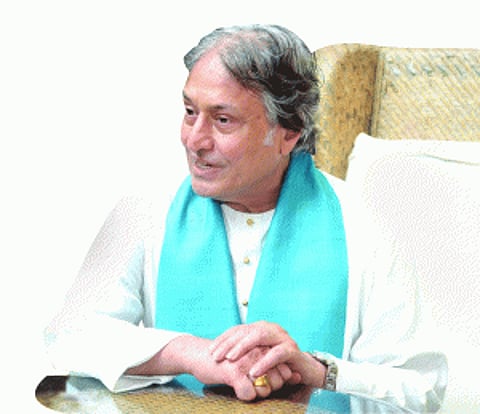

Sarod maestro Ustad Amjad Ali Khan will perform Samaagam, a concerto for sarod and orchestra in Music for life, tomorrow. It’s an attempt to explore commonalities between Indian and Western classical music systems. He speaks to Saritha Saraswathy Balan about the concert, the music project Amalgam and his musical journey so far
Amjad Ali Khan feels that music has the ability to transform any situation. So will be his performance in Music for life, a show to highlight the country’s role in the eradication of preventable cataract blindness. He will get together with conductor George Mathew and American classical violinist Elmira Darvarova for the Western Classical musical concert.
“In India alone, there are nearly 15 million women, men and children suffering from cataract-related vision impairment and total blindness. In this room, we have the ability to transform this situation. Our role comes up from the beautiful music that we will hear. Music has the power to transform. The role is to be a witnesses to all those affected by cataract blindness. Each one of us have to take action in our own way to bring light and indeed new life to those who would otherwise remain bound in darkness,” he says. “The concert throws light on the possibilities that can blossom when a community comes together and acts,” he adds about the show organised jointly by HelpMeSee and Music for life International.
About Amalgam, latest concert project, Ustad says that it is a follow-up on the highly acclaimed album Soul Strings released in September last year. “My sons Amaan Ali Bangash and Ayaan Ali Bangash joined with violinist Elmira Darvarova to create a unique collaboration. Darvarova is a Grammy-nominated concert Violinist, former concert master and artistic director, New York Chamber Music Festival. Amalgam brilliantly brings together this daring, supercharged, yet profoundly respectful and even affectionate meeting of these musical minds,” the maestro says.
Music is a universal language and breaks all barriers. At the same time, man made barriers sometimes block cultural exchange. While asked about being denied a visa to UK recently, he said, “Musical vibrations can convey moods, emotions and have the ability to mould and shape our consciousness. Music has many faces-,conversation, recitation, chanting and singing are all part of music. Instrumental music ispure sound. It needs to be experienced and felt. Since there are no lyrics, there is no language barrier between the performer and the listener. I am grateful to the British High Commission for finally granting me a visa. It was one of my most memorable concerts in london,” he believes.
In classical music, improvisation is not that easy. How are you able to constantly bring modifications in the SarodIJ” “I am very glad that today, Sarod has become a universally known Indian instrument. Even in the West, Sarod is very much loved by many. My family is on a collective mission to make this beautiful instrument as popular as the guitar. Since my childhood, I always wanted my instrument, the Sarod, to express the entire range of human emotions,” he says.
“Sarod Ghar, my ancestral home, that was converted into a museum in 1995 displays instruments of the great masters of music. Ustad Haafiz Ali Khan Memorial Trust, which runs the museum, has dedicated its work for the past two decades for the propagation and preservation of Indian classical music. Work on compiling a database on classical music in the form of books, articles and audio-visual recordings is progressing,” he adds gleefully.
Heard that you have once said that our classical artistes are not well known for voicing their opinions beyond the world of music and danceIJ
He continues, “My guru often told me that he did what he felt was right and I should do what I feel is right. I still remember the love and warmth Ireceived from revered Jiddu Krishnamoorthy, the great philosopher and guide. I hope the legacy of ‘Guru-shishya parampara’ will facilitate the growth of knowledge and wisdom in harmony with well-deserved Indian traditions.”
Ustad feels the constant presence of a power. “For someone like me, who grew up in an atmosphere of classical music, with strong values of tradition and humanity, I feel that every moment has been possible with the guidance and protection of a power, in a world full of hope and at the same time disappointments”, he says.
Ustad has seen much and he adds about his fresh experiments with music and Sarod. “There is a new Sarod Concerto on the line and also many concerts are coming up this season. I also look forward to performing with Asha Bhosleji in the coming month in Mumbai”, he adds.
When asked about his view of life, musical journey and the musical saga of his family, Ustad said that Amaan and Ayaan today do strike a correct balance between the two worlds of traditionalism and contemporary times.
“I see a great journey of Indian classical music being carried forward by brilliant musicians of the younger generation. I am very happy that there are young dedicated musicians. They are also committed performers”, he says.
And about the most amazing experience in his life. “The arrival of my grandchildren, Zohaan and Abeer, twins who are four-and- a-half years old. They are the greatest attraction in my life. I am very blessed to have a wife like Subhalakshmi who has been and is an integral part of my life”, he signs off.