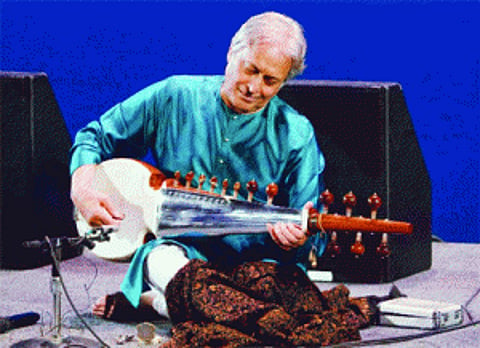

A few hours before his mehfil at the World Sacred Spirit Festival, sarod maestro Amjad Ali Khan shares his views about the new wave of collaborative music and his concerns about people losing interest in the pure art forms. Shrabasti Mallik reports from Jodhpur
As the sun set beyond the walls of the majestic Mehrangarh Fort and dusk settled in, it created an atmosphere so ethereal that very few things can compliment, like a mehfil by Ustad Amjad Ali Khan accompanied by his sons, Ayaan Ali and Amaan Ali. On the second day, or we would say night to be precise, the four walls of the Zenana Deodi Courtyard came to life as it echoed with the maestro performing some sublime ragas and leaving the audience wanting for more. “This is a one of a kind festival,” ustadji told us as we sat with him a few hours before he took to the stage. “Although my sons have played in Jodhpur before, this will be the first time that I will be playing with them here,” he added.
More than the much awaited performance at the World Sacred Spirit Festival, what worried the maestro more was the fact that why the world is losing interest in the pure art forms. It agonises him to think that today people are more interested in collaborations. “It is a big question and it bothers me because this is a concern not only in India but the world over. Even my sons get invited for collaborations but apart from a few, they respectfully decline saying that they would perform only if people want,” said ustad ji, who considers collaboration or fusion as a deterioration of art forms. “It is like an adjustment. But we are capable of adjusting — we are not animals,” he quickly added.
But considering the work that he has done with the Scottish Chamber Orchestra (SCO), ustad ji is not strongly opposed to the idea. “There is nothing wrong in it though,” he said and shared that when he was invited by the SCO to compose for them, he did. “I named it Samagam and it is the world’s first sarod concerto. We have travelled the world with it and have had seven shows in France apart from numerous shows in India,” he pointed out.
Speaking on the lines of originality and creating compositions of our own, he mentioned that the reason why we are unable to come up with better symphonies and orchestra is because there is not much awareness. “We have adopted so much from the West, but still we cannot produce a symphony orchestra like them, neither at the national nor at the international levels. Now there is little awareness and small orchestra groups are coming up in Chennai and Mumbai but the sad part is that they all get musicians from outside,” he shared.
Just by being with him for a few minutes, one can learn so much about our culture and Hindustani music. And the best part is ustad ji makes it so easy to understand. He told us about the saying ‘swar hi ishwar hai’ and said that it is difficult to explain to depth of the saying in words. “We crudely translate it to, ‘music connects you to God’,” he said and added that it is important for people to understand that there are two types of music in the world. “One is the pure sound or what we call the symphony where there is no language involved. It is the purest kind of music. The other kind that becomes more popular is dependent on language or text. With all due respect to language, I feel that language creates barriers. Music is for all, it’s universal because it has the seven notes as its base. So no matter where you are, which genre you play — the roots remain the same,” he elaborated.
For a maestro who left his formal education to dedicate his life and time to the instrument, education cannot create kindness and compassion in a human being. “I left school when I was 12, in 1963, when a group of Indian artistes travelled to America. And all that I have learnt from music and the values that I received from my elders. They are the greatest teachers,” the maestro wrapped up.