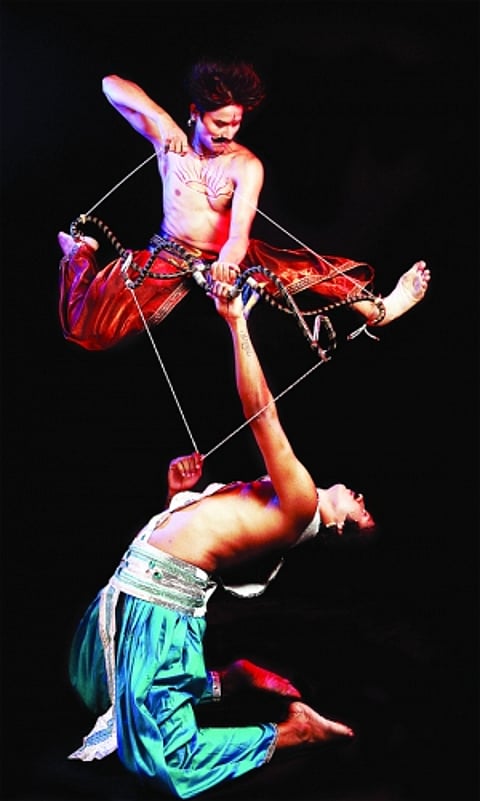

Krishan Verma’s choreography depicts the dilemma faced by Guru Dronacharya. By D Kaushik
Draupadi, Yuddhishthir, Arjun and Karn — from time to time characters from the epic Mahabharata have been of great interest to poets, authors, artists and dancers. While some works explore the personality of the characters in the light of events as recorded in our history, a few talk about their relevance then and now.
Krishan Verma didn’t want to explore the obvious and therefore chose the character rarely discussed and spoken about in the creative space.
He designed a choreography Drona to narrate the story of Dronacharya and bring out dilemma he faced at various points in the story of Mahabharata. Some of the dilemmas were about rejecting Karn as his student as to the best of his knowledge he was not part of the Kuru putras, asking from Eklavya his thumb as a guru dakshina so that he doesn’t stand against his favourite student Arjun and ultimately the biggest one — being with the Kauravas in the war of Mahabharat, despite knowing that he is going against the right and he will be fighting his favourite students, but he was bound by his commitments.
“His story also throws light on the fact that a teacher distributes his knowledge equally among his students, now it is upon the students to use that knowledge for the good or bad. Both Pandavas and Kauravas were trained under Dronacharya but how come Pandavas picked up the right values and ethics while Duryodhana even used his shastra vidya for his selfish motives. The story also shares that it is difficult to change the basic nature,” said Verma, who will be presenting his dance drama Drona for the first time in Delhi today at Shri Ram Centre at 7 pm. Verma informed that it is for the first time that someone has designed a dance drama with the help of dance forms like Chhau and Kathakali. Forty-minute sequence has over 17 trained Chhau dancers and music is specially compiled with traditional Chhau music.
The first scene begins with the description of early life of Drona. “Drona was born in Dehradun. He got education in the four vedas and military arts such as archery living in a ashram with his father Rishi Bhardwaj. learning that Parshuram was giving away his fruits of penance to Brahmins, Drona approached him. Unfortunately, by the time Dronacharya arrived, Parshuram had given away all his belongings to other Brahmins. Parshuram offers a choice to Drona — either his body or his weapons. Drona decides to take the weapons, their use and withdrawal techniques. Parshuram agrees to it and thus Drona obtains all of his weapons and knowledge. Thus Drona becomes a sage of guru Parshuram and gained education from him. According to the guru-shishya parampara a student learns from his guru and later that student becomes a guru and passes on the education to another generation. We show how Drona becomes a royal guru to the Kauravas and Pandavas,” stated Verma.
The second scene depicts the Eklavya episode and education of Kauravas and Pandavas.
The third scene brings into picture Karn. And the fourth and the final scene moves to the battlefield of Kurukshetra. “When the war was declared and the two armies were facing each other, Arjun realised that he would have to kill his dear great-granduncle (Bhishma), on whose lap he had played as a child, and his respected teacher (Drona), who had held his hand and taught him how to hold the bow and arrow, making him the greatest archer in the world. Despondent and confused about what is religious, what is right and what is wrong, Arjun turned to Krishna for divine advice and teachings. Krishna, who Arjun chose as his charioteer, advised him to do his duty. Krishna instructs Arjun to fight his kin, for that was the only way to righteousness. He also reminded him that this was a war between righteousness and unrighteousness (dharma and adharma). The death of Duryodhan marks the end of this great battle. The battle thus presents itself as a battle of truth against evil and the subsequent victory of the truth and dharma over untruth and crime. You have to walk and create your way. A guru teaches and guides, a shishya chooses and applies. The drama is full of lessons,” ended Verma.