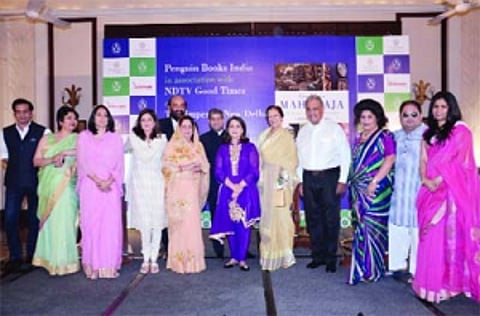

In her book live like A Maharaja, Amrita Gandhi shares how to accessorise and drape sari like Maharani Gayatri Devi and create luxury out of the ordinary. She talks to Divya Kaushik about her encounters with royals and discovering their lifestyle secrets
little did Amrita Gandhi know that meeting a person, she once spoke to casually at a coffee shop in Delhi, at his residence in ladakh would be the most exotic experience of her life. Then an anchor of a travel show, Gandhi, was asked to carry white silk scarf to meet Raja Jigmed Namgyal of ladakh at Stok Palace. The Raja walked in with a procession draped in a serious silk robe. “Discovering the rituals, knowing the history and chatting with the raja was one of the most interesting experience I had. I was transferred into a different world,” commented Gandhi, who recently launched her book live like A Maharaja: How to Turn your Home into a Palace (Penguin) at The Imperial in the presence of many royalties. As the title of the book suggests, in the book Gandhi gives tips on how to dress like royals, decorate one’s home like a palace and some recipes from the royal kitchen. “After anchoring a few seasons of Royal Reservation, we thought of coming up with the book which is not a mere account of my experiences but which guides people to convert their places into a palace,” shared the author. She added, “Here you will see how a bandgala waistcoat with a secret cut can do the talking for you at a dinner party. A hostess shares just where and how to break the rules of a conventional table setting, and the ingredients are revealed of a home-made beauty scrub given to a princess the day before her wedding. If you are looking for intrigue in this book, there is that too.”
Through designer Ritu Kumar, Gandhi heard a story of maharani who, when she lost her husband, turned around conventional ideas of wearing a white nine-yard sari, while still doing just that. Except, she did it in chiffon. And with that, a rage for chiffon was born. Sayajirao’s daughter, Indira Raje, went on to become one of India’s biggest royal trendsetters. After her husband died, she chose to only wear a white sari. “Kumar told me that the last thing Raje wanted was to look like a bundle in white malmal, so she got her nine-yard white chiffon sari woven in lyon — the finest chiffon you could find,” said Gandhi. In the book, the author says that one should choose a chiffon sari with little or no embellishment. It should be either a single colour or shaded, like green going to yellow. The colour of the brocade border should ideally be lighter than the body of the sari, dominant in silver or gold with a pattern reflecting subtly the colour of the sari. When working with printed chiffon saris, choose a finer all-over print rather than a loud design.
In the chapter, Your Home, Your Castle, the author gives examples from the palaces across India about the use of marble, glass, placement of antique books and diaries, portraits and arts in princely homes to gives ideas to the readers. “Hanut Singh’s home displays beloved objects, none of which succumbs to any particular aesthetic. He releases them completely from conformity and us from the feeling that royal means grand art or grand anything for that matter. And then we have a successful interior designer, Adil Ahmed, who might conceptualise an entire room on the basis of a single motif. Adil’s irreverent ikats may not be for everybody but they certainly give us the freedom to go ahead with the wildest of ideas provided we know what we want to do with them. One of his most useful ideas is how to make a small, even windowless, space appear formal, inviting and big,” concluded Gandhi.