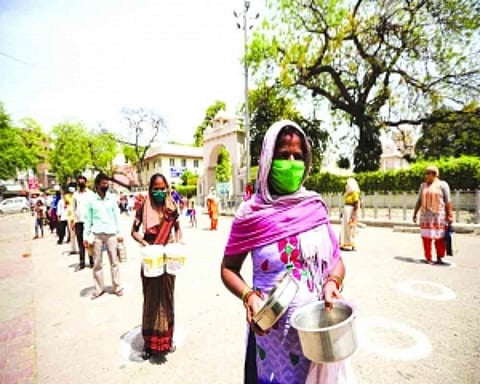

Effective strategies, if adopted timely, can halt the economic disaster which is set to unfold in rural India, says Arun Jindal
The second wave of Covid-19 caused devastation across the country. Every day headlines about the steep rise in the number of positive cases and deaths created an environment of fear. Seeing the health infrastructure crumbling down, state governments, after initial reluctance, started announcing lockdowns and curfews in respective regions to curb the infection. The restrictions, once again, wreaked havoc on the marginalised sections of the society, especially in the rural districts that accounted for 50 per cent of all new cases by mid-May in the country as per a report by the State Bank of India (SBI). Daily wage laborers, migrant workers, hawkers were the worst affected.
“As a hawker, I have not been able to work due to the lockdown and restrictions that have been put into place over the last one and a half year,” shares Gopal Banjara, a resident of Basedi Municipality in Dholpur district of Rajasthan. His biggest concern is his family that includes three small children. He is unable to make ends meet as the lockdown ceased his way of earning a living.
With no savings, Gopal fears for the well-being of his family. When informed about the Rajasthan government’s Mukhya Mantri Chiranjeevi Swasthya Beema Yojana, a scheme that provides free treatment at any government or private hospital, he said that he wasn’t aware of this particular scheme.
According to a survey conducted by the National Hawkers Federation in 2015, there were over four crore hawkers in India who sold products worth Rupees 2,000 on average per day. Many of these hawkers are now finding it difficult to survive or even restart their businesses.
Gopal’s son, a daily wage laborer, is sailing in the same boat. To arrange for food and other basic needs of his family, he has taken loans from several people.
It is not only the unskilled laborers from the informal economy who have been affected. Dilip Kumar Sharma, who has completed a nursing course, is also struggling to survive the Covid-19 lockdown. A resident of Dehri Village of Sepau Panchayat in Dholpur district, he claimed that despite vacant positions, the concerned department is not inviting applications. Due to a lack of opportunities in his field, he has been forced to work as a laborer in the private sector where his earnings are insufficient to meet his family’s needs.
However, to add to his woes, the lockdown has left him unemployed, and he is now looking for work. Despite having a prime professional education, Dilip has no income and therefore, has taken a loan for his family’s survival. “It has become difficult for the poor to live because of Coronavirus. We are struggling hard for our survival. People are compelled to commit suicide as they are unable to fulfill their household needs,” rues disappointed Dilip. “I urge the administration to secure a livelihood by providing employment opportunities to the unemployed, destitute people either through NGOs or on a contractual basis,” he adds.
Laborers, who miss out on government schemes due to corruption, are now apprehensive to migrate from their villages in search of jobs fearing sudden and frequent lockdowns. Haunted by horrid experiences they had to suffer during the lockdown last year, moving out from the village is not an option anymore. Helpless, they are compelled to borrow money at a high rate of interest to feed their families. Unknown and uncertain about Covid-19, they are unsure of when they will get back to work, earn and repay these loans. The pressure is mounting on these laborers as the prediction of the third wave is making the headlines.
Dilip also expresses his concern about the devastating impact of Covid-19 on people’s future. He shares how the situation has adversely affected children and their education. The desperate ways with which children belonging to low socio-economic backgrounds are managing to attend classes online hints towards their uncertain future. There is no guarantee of how many of these would return to schools.
Another problem that several people, including Dilip, are facing is the corrupt practices followed by dealers while distributing ration under government schemes. These schemes are unable to produce the desired result due to a lack of adequate monitoring at the grassroots level. And, in times like these, it impacts the life of the poor in the worst possible ways. There are media reports that suggest that rural communities are eating less and often not able to afford nutritious food like pulses and vegetables.
Raghuraj, a daily wage laborer from Dharampura village in Basedi Panchayat of Dholpur district who has been unemployed since last year, claims that he has received no benefit from any of the development schemes as he has no money to bribe the officials. With no employment opportunities, in villages or in cities, his family, like several others, is surviving on loans.
Kamlesh, another resident from the same village shares, “We slept hungry for three days when my husband could not find work due to the lockdown.” India’s rural poor, undoubtedly, has been pushed further away by this pandemic. There is a dire need to adopt effective and timely strategies to stop the humanitarian disaster waiting to unfold in rural India.
—Charkha Features