
Mapping India’s multilingual imagination at the Delhi Book Fair Sakshi Priya
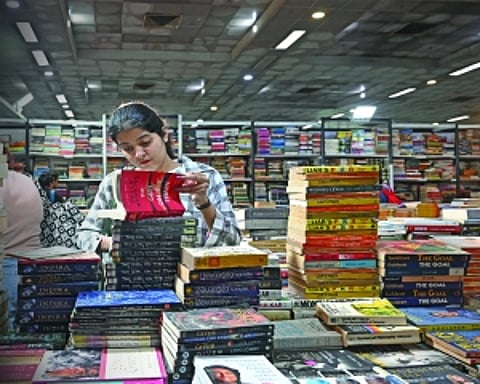
There are few places left in the world where time seems to pause — where curiosity takes precedence over urgency, and the act of reading is not a retreat but a quiet rebellion. The Delhi Book Fair 2025 is one such place. Within the cavernous expanse of Bharat Mandapam, surrounded by towering stacks of books and the low murmur of literary exchange, one enters not a market but a sanctuary. A sanctuary where words reign, and stories — printed, bound, and preserved,whisper across languages, generations, and ideologies.
Now in its 29th edition, the Delhi Book Fair has transcended its commercial foundation to become a cultural institution — one that mirrors the intellectual and linguistic plurality of India. It is where the traditional art of publishing intersects with the evolving contours of a knowledge-driven economy. This year’s fair unfolds under the banner: Books and Publishers: The Future of Multilingual India. But the real story lies beyond the theme — in the voices it amplifies, the silences it breaks, and the futures it dares to imagine.
From the eloquence of regional literature to the authoritative clarity of academic publishing, from children’s fiction to political memoirs, the spectrum is dizzying. In one aisle, Rajkamal Prakashan offers a profound dive into Hindi literary heritage, while in another, Sahitya Akademi showcases the quietly powerful works of authors writing in Meitei, Dogri, Bodo, and Santhali. The linguistic fabric of the country, often frayed by neglect — is here visibly rewoven, with each title a stitch in the larger narrative of inclusivity. It is worth pausing to consider what this multilingualism truly represents. In an era increasingly defined by algorithmic uniformity and linguistic homogeneity, to publish in a non-dominant language is an act of cultural assertion.
It resists erasure and insists on complexity. And in this regard, the Delhi Book Fair performs a quiet revolution — it dignifies diversity not as tokenism but as necessity. One particularly compelling encounter was with Tara Books, the Chennai-based independent publisher internationally recognised for its handcrafted books and tribal art collaborations. Their presence at the fair underscored the idea that form is as vital as content, and that publishing, when approached with integrity, becomes a form of visual and intellectual storytelling. Their edition of The Night Life of Trees, illustrated by Gond artists, continues to be a luminous example of how indigenous voices can find global resonance without cultural dilution.
Beyond the literary stalls, the adjoining Stationery Fair and Office Automation & Corporate Gift Fair (Halls 12 and 12A) reflect the infrastructural evolution of reading and learning. The integration of educational tools, digital solutions, and corporate communications into the same physical space as literature signals a broader ecosystem-where books are not isolated artefacts but nodes in a larger knowledge economy.
As the fair winds down and the last books are bagged, what remains is a memory of titles browsed and of voices encountered, boundaries blurred, and futures imagined. A world accelerating toward sameness, will we still turn to the quiet power of books to remind us who we are and who we could become?
Cartography
As both journalist and reader, one cannot leave the Delhi Book Fair untouched. Books are encountered as vessels of voices, philosophies, and cultural memory. Here, literature reclaims its rightful role in public discourse — not as an exclusive pursuit, but as a democratic inheritance anchoring thought, language, and identity in a multilingual nation’s collective consciousness.