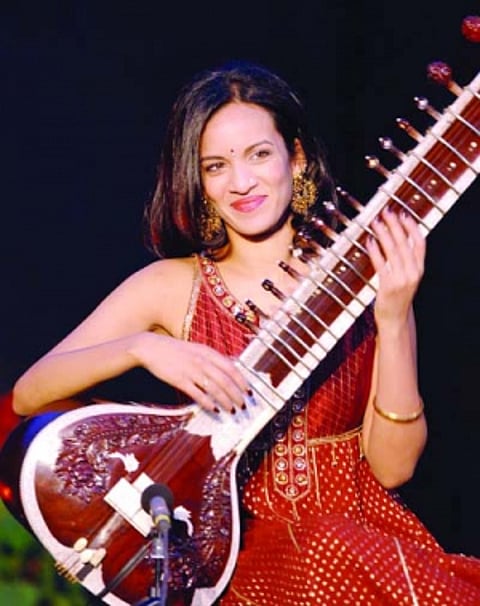

Anoushka Shankar's seventh album reflects her influences and bonding with sister Norah Jones. She chatted with Karan Bhardwaj
Sitar player Anoushka Shankar is committed to both conserving her father’s musical philosophy and adding new sound spaces and contexts. The 32-year old artist not only served her apprenticeship in Indian classical music under Ravi Shankar and performed on stage with him for nearly 20 years, but also benefited from a curious and open-minded upbringing across three continents. She released her first album, Anoushka, in 1998, when she was just 17, and since then has worked with musicians as varied as Sting, Herbie Hancock, Jethro Tull, Concha Buika, Mstislav Rostropovich and Thievery Corporation.
Shankar’s seventh album, Traces of You (Universal Music India), is inspired by the idea that everything in the universe leaves an indelible mark on everything else it comes in contact with. Anoushka drew on her relationships and multicultural lifestyle to trace a journey of love, change and loss. Excerpts from an interview:
Please share the beginning of Traces of You.
I started working on this album last year and took a year to complete it. It’s based on the idea of influences…how different influences of parents, music, culture and lifestyles affect me. Everything leaves traces and it’s about living and learning with them. I was fascinated with the idea of sharing my influences.
last two years have been eventful in your life. How difficult was it to compose an albumIJ
On a musical and technical level, it was challenging but not difficult. I was writing the music which I am fond of. I always love working in multicultural set up. I am fascinated how different instruments work together. There was time when it was incredibly difficult. I had lost my father, became a mother... so much happened. But as an artist, this album was helpful. I could put my emotions, anger, happiness, in music. It was an intimate affair.
Is there any anecdote regarding the track Unsaid in the albumIJ
A few weeks after my father’s demise, I was flying to New York to record with Norah, and wrote these lyrics on the plane. She sat at the piano trying out a new melody, and as she sang, I realised she was singing phrases that were astonishingly close to the beloved musical theme our father wrote for Satyajit Ray’s film Pather Panchali decades ago. I asked her about it, and she told me she’d never heard that melody before. It is small, inexplicable moments like these that fill me with gratitude and awe.
Tell us about your bonding with Norah...
We are very close no matter what people say. We have a great relationship. But we don’t get much opportunity to work together. During this album, we spent more time writing and making music. She is a wonderful musician and a versatile artist. Working with her during such a demanding period of life was an emotional journey.
Is there ever any sense of competition between the sistersIJ
Not at all. We belong to different genres of music. So there can be no competition between us. In fact, we are supportive of each other’s work.
In the touring career of 20 years, you have just released seven albums. Why do you record in gapsIJ
I have had two long gaps. There were three albums in a row, then there was a gap. The reason is that I still consider myself a touring artist. During my concerts my entire time is devoted for my performance. Also, I come up with an album when there is something to say. I have never been in rush to release albums. It’s wise to take time and make music when it is required.
Do you feel pressurised to take your father, Pt Ravi Shankar’s, legacy to a new levelIJ
I have felt that pressure all the time but I have learnt to deal with it. I have inner commitment to spread his music. Since he is no more with us, that passion has become even stronger. I want to spread my father’s legacy as far and strongly as possible.
Tell us about your role in Ravi Shankar Foundation.
It’s very early to comment for me doing anything with the Foundation at the moment. They have been organising events and regular festivals. We have different roles to play. I don’t want to take on things that are not meant for me.
How do you look at the problems of classical music in IndiaIJ
There’s a lack of patronage from private corporates. I think Indian classical music needs more private funding. West is a good example in this case. Every kind of music can co-exist together. West is structurally placed when it comes to music. They have opera houses for operas, clubs for jazz, stadia for pop music etc. The problem in India is that one form of music dominates the other. We are not very appreciative of art.
Your experience as a mother...
Zubin is two and a half now and is doing wonderful. I think parenthood comes with a lot of changes. Most people change their lives to adjust with kids. It’s difficult to tell how I am changing but it’s one of the most wonderful experiences. It’s a fundamental shift to become a caring mother.
Do you play your tunes to ZubinIJ
Yes! He is very much part of my music. He comes to rehearsals and accompanies me on tours. He, in fact, recognises some music and asks for it. I should tell you that he listens to old Hindi songs. He thinks lata Mangeshkar is a baby like him since she sings in a very high pitch. So he asks for ‘lata baby’ music. It’s really cute.
You were quite vocal about the Delhi gangrape case. What’s your reaction to the verdictIJ
I find it difficult to answer. The verdict has been given. For family and many others, it may be a closure. But I am fundamentally opposed to death penalty. I don’t agree to it in any situation. I don’t support death sentence.
Today it is this case, tomorrow there will be another case. It’s sad that brutality exists but you cannot stop it with death penalty.
When are you touring IndiaIJ
I am coming in December. It will be a multi-city tour. Organisers are still working on details. I may perform in Delhi, Mumbai, Hyderabad and couple of more cities. Then I will come back in January next year.