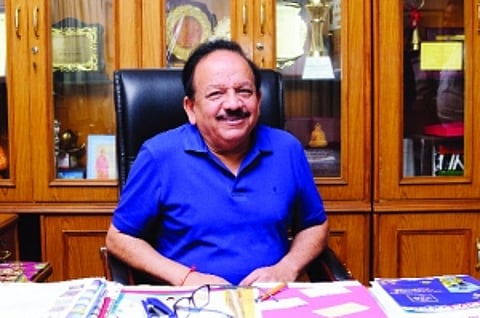

The Ministry of Environment recently standardised conditions for 39 sectors to facilitate speedy and automated clearances. DR HARSH VARDHAN, speaks to ANKITA SAXENA about the various other initiatives undertaken by the ministries under his charge and how India is making progress on becoming a scientific global leader
The Union Minister for Science and Technology; Environment, Forests and Climate Change and Earth Sciences, Dr Harsh Vardhan, has spearheaded many projects to give a fillip to the scientific research in the country. His ministries have also made sure that progress is made keeping in mind the ramifications on the environment and thus put checks and balances to curb the adverse impact. Excerpts from the interview:
What is the purpose of the standard conditions for environment clearances released by the ministry? How will it boost ease of doing business?
The purpose of environment clearances is to ensure that the activities governed under the Environmental Impact Assessment Notification, 2006, are carried out considering the environmental imperative related to air, water and soil. Compliance with these conditions will ensure sustainable development without impacting the ambient environment adversely. We have recently standardised the conditions related to 39 sectors to ensure coherence and consistency in the approval process and remove arbitrariness. This process will bring transparency in the process of approvals and further facilitate automation of the entire process of submitting the Environment Clearance (EC) application. It will also improve the ease of doing business as two similarly placed units would be able to predict the nature of approval and plan for it in advance. It has been noted that only some aspects are unique to a project while a large part of it is applicable to many others. The unique aspects of the projects will be handled as a specific part of the conditions. The standard EC conditions shall be considered by the Expert Appraisal Committee at the time of appraisal of the proposals. We recently launched ‘Parivesh’, a path breaking initiative that would allow a project proponent to track the approval process at each stage and automate many aspects of of it, thus, reducing the time taken for approvals. It will also facilitate environmental compliance leading to sustainable development.
How is the ministry fostering R&D in the field of environment and climate change?
The ministry has a special scheme called Research in Environment (RE) to promote R&D. We have supported the proposals received from various institutions in the past and are currently assessing their outcomes. It is proposed to prepare a compendium during the current year of all R&D projects completed during the XIth Five Year Plan (2007-2012) and the XIIth Five Year Plan (2012-2017) to bring out the achievements of these projects. Under the new R&D scheme for Conservation and Development, we have identified eight thematic areas and specific topics for research which will be directly relevant to the ministry’s priorities. Our focus in the future is to strengthen our knowledge base so that the research can contribute in prevention, control and mitigation of pollution (air and water), waste management (plastic, hazardous, e-waste) and conservation of biodiversity and wildlife.
What initiatives have been taken by the ministry to enhance human capacity building in the field of science and technology?
We have launched several new schemes to encourage and attract young researchers to engage in R&D activities. Some of these new schemes include the Early Career Research Award which provided a quick research grant to around 1,500 young researchers; the National Postdoctoral Fellowship (N-PDF) Scheme which provides around 600-700 fellowships annually; the Overseas Visiting Doctoral Fellowship which will be given to 350 fellows during 2016-19; the Visiting Advanced Joint Research (VAJRA) Faculty Scheme has selected 43 visiting faculty and so one. Similarly, the Council of Scientific and Industrial Research (CSIR) provided various doctoral and post-doctoral fellowships for human capacity building to around 18,000 researchers in the last four years. The KIRAN (Knowledge Involvement in Research Advancement through Nurturing), launched in 2014, is women-exclusive scheme which supported around 1,600 women scientists. The Department of Biotechnology (DBT) is implementing an integrated Human Resource Development Programme in multidisciplinary areas of biotechnology.
Extra-mural R&D project support is the key mechanism to augment highly skilled scientific manpower in the country. We have made concerted efforts to convert brain-drain to brain-gain. The Department of Science and Technology (DST) and DBT are the two major players contributing nearly 66.4 per cent of the extramural R&D support in the country.
Please elaborate on the innovations and technology development projects
The business incubation facilities have been almost doubled. During 2018-19 itself, 15 new biotechnology incubators and 15-20 new technology business incubators will be established for start-ups. Biotechnology Industry Research Assistance Council (BIRAC) alone would support 300 additional start-ups next year. BIRAC has launched the Biotechnology Innovation Equity Fund —AcE Fund, which is a fund of funds to scale-up R&D and innovation in biotechnology domain. This will infuse more than Rs 350 crore in the biotech innovation start-up ecosystem.
The MANAK (Million Minds Augmenting National Aspiration and Knowledge) is another large initiative to foster culture of innovation through the power of relevant ideas and their translation for students of class 6-10. MANAK targets to award one lakh of the best ideas/innovations of school children every year.
SITARE (Students Innovations for Advancement of Research Explorations) for school children has been launched by the BDBT which has awarded 100 appreciation accolades of Rs 1 lakh each. The first ever Industry-Academia mission to accelerate biopharmaceutical development in India viz. National Biopharma Mission was launched in June, 2017. The Innovate in India (i3) program which involves an investment of $250 million with $125 million as a loan from the World Bank, is a game changer for the Indian biopharmaceutical industry. CSIR is also promoting innovations through its mission mode projects such as aroma mission, phytopharmaceticals mission, mission on mass housing, food and consumer safety solution and so on.
How is the ministry strengthening its services for socio-economic benefits?
The quality of weather services has shown appreciable improvements during the past four years. The loss of lives during the last four years due to tropical cyclones has reduced to less than a hundred as compared to the thousands during the previous decade. The Heat Action Plan is being implemented in cities across central India including Ahmedabad, Surat, Nagpur, Akola, Gondia, Chandrapur, Nanded, Jalgaon, Bhubaneswar and Cuttack. It is a comprehensive early warning system and preparedness plan for extreme heat events which has resulted in the decrease in the number of deaths from about 2,400 in 2015 to about 220 in 2017.
The Ministry of Earth Sciences (MoES) in collaboration with the Indian Council of Agricultural Research (ICAR) provides the Agromet Advisory Services (AAS) for the benefit of farmers. The farmers make use of these services for planning tasks like sowing, irrigation, application of fertiliser and pesticide, harvest and protection of crops from weather disasters. Currently, about 42 million farmers are receiving crop specific agro-meteorological advisories in vernacular languages.
In the health care sector, the Ministry of Science and Technology has contributed a great deal. The first indigenous low-cost Rotavirus vaccine from an Indian strain was launched in 2015 which aims to save lives of millions of children from diarrhea.
Many affordable drugs, diagnostic kits and health care products have been developed and transferred to the industry for commercialisation. The economic impact of streptokinase technologies developed by CSIR is about Rs 580 crores for the patients.
We have recorded much success and demonstrated several solutions for providing safe drinking water at affordable cost and in adequate quantity. The S&T projects on water for 20 site-specific challenges covering around 400 habitats across 23 states are continuing.
The CSIR is also offering skill development programme to farmers through various means.