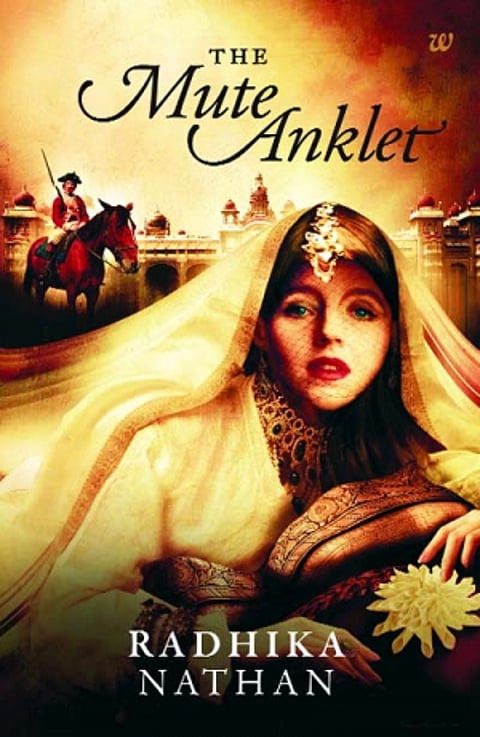

Radhika Nathan’s (pseudonym) first book, The Mute Anklet, is about the dilemma of an English girl in the middle of the third Anglo-Mysore War. Iknoor Kaur finds out reasons behind her alias and explores her love for history
JK Rowling calls it a way of “working without hype or expectation”, while others tag it as a “publicity gimmick”. However, Radhika Nathan works under a pseudonym because she sees a different side of her through the personification. Having written on her blog for years under this alias, she recently introduced her first book, The Mute Anklet (Westland). “I am a working woman who has a passion for writing. The pseudonym helps me keep my writing separate from my work. I like the idea of writing under this name because I have done it for so long. It is a different part of me and I want to keep it like that,” shared the Bengaluru-based author.
Set in 1792, amidst the Anglo-Mysore War, Radhika’s novel looks beyond blood and sweat. She dwells on the character of Uma Brooke who is the daughter of an Englishman, in the care of the Maharaja of Mysore. Through the torment and torture of men at war, the book takes the reader through her dilemma which is embroiled in personal conflict. The writer explained, “Even though set in 1792, Uma is in some ways a character that has modern dilemmas. She is English by her look, but feels very Indian because she was brought up here. Her self-identity is Indian although her nationality is English.”
Radhika says that because of her love for history the story is set in the 18th century, but it takes inspiration from real time personalities. “The inspiration is from a lot of people who move out of their countries and adopt another nationality. Even though officially they may be from their birth place, their thought process, behaviour and mindset is from the place they were brought up in. The question is how do you identify yourselfIJ Are boundaries like race and class important and are we being treated the way we want, in spite of how we lookIJ”
Nathan doesn’t call the story a self-encounter or a personal saga, but admits to the delineation of her persona in the characteristic mould. She said, “An author always puts a little bit of herself in the story. There are a few tight spots that the hero faces and bits which are taken from my personal quandary. The character for me is the most important.”
To set a story in the era where one war led to another, a lot of research was needed. Radhika quipped that by the end of it, she didn’t even use all the data from the piled up study.
“I read a lot of books about the period, the kind of clothes they wore, their food habits and how the city looked in those days. Being a first time author I’ve tried to put a lot of things in the book so that there aren’t any loose ends. But, I’ve still not put in all of it,” she added. Even though her book comes across as a historical romance, Radhika thinks otherwise, “I like to think of it as a genre-bending novel that curves itself on different levels — history, mystery and romance.”
She is now working on two other books and doesn’t plan on revealing her identity anytime soon. “I am working on a contemporary novel set in the 80s and another in the present times.”