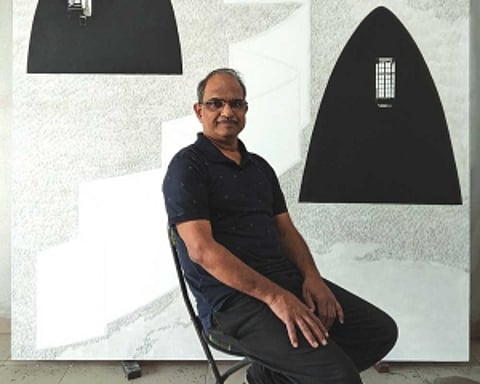

Stillness can speak louder than movement, and in Yashwant Deshmukh’s art, silence acquires its own architecture. His solo exhibition, Horizons of Memory, at Art Alive Gallery, meditates on space, absence, and the quiet weight of memory. Through muted tones, abstracted forms, and textured surfaces, Deshmukh creates visual atmospheres that exist between the visible and invisible, the familiar and imagined. Artist has long explored the metaphysical qualities of form, and this exhibition continues that pursuit. Doors, walls, crevices, and voids are not literal structures but contemplative sanctums, spaces suggesting solitude, shelter, and reflection. His approach is not nostalgic for his childhood in Vidarbha; rather, it stems from a fascination with the textures of memory and the atmospheres surrounding everyday objects.
Memory is expressed as ambience, rendered in surfaces that are tactile as well as visual. The exhibition features works that embody this sensibility. Home-1 (Acrylic, Marble Powder & Pencil on Mounted Canvas) captures the simplicity of a bare structure, its textured surface carrying the quiet weight of time. Home-2 (Ink & Pencil on Paper) reduces a dwelling to its minimal essence, like a fading memory. Invisible Love (Acrylic on Canvas) evokes intimacy without representation, where absence itself gestures closeness. Home with Glass Bead Curtain (Acrylic, Marble Dust & Graphite on Canvas) explores concealment and revelation, inviting viewers to pause at the threshold of seen and unseen. Home-Land (Acrylic & Graphite on Canvas) links interiority with belonging, a pared-down form both rooted and fragile, echoing memory’s resilience.
The paintings’ subdued palettes and minimalist compositions conceal intricate dialogues of light, shadow, and resonance. The lack of figures heightens meditative stillness, allowing the viewer to inhabit the space. Materiality is central, acrylic, graphite, marble dust, and ink reveal texture as much as form. Objects are stripped to their essence yet charged with depth, the process meditative, where material becomes metaphor. In Horizons of Memory, emptiness is eloquent, and stillness emerges as presence. The exhibition is less a display of paintings than an invitation to slow down, to inhabit silence until it begins to speak.