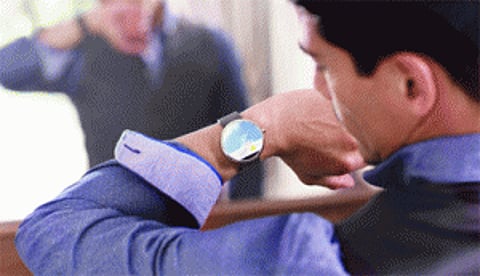

With Google's operating system and Apple's ‘iWatch' project for wearable devices, the smartwatch industry has got a fresh lease of life. However, experts say manufacturers will have to think out of the box to tap the potential market. By Karan Bhardwaj
Exchanging emails, text messages, updates from social networking websites, searching stuff on Google… now everything’s available at hand! We are not talking about your phone, but a smartwatch that rests on your wrist. After mobile phones, smartwatches have caught the world’s fancy as big players like Samsung, lG, Motorola and Apple are injecting a fresh impetus to the evolving industry. While Samsung’s Gear live is impressing geeks for its add-on features, Motorola’s Moto 360 is earning brownie points for its fashionable design. The latter is expected to hit Indian markets soon. According to reports, the smartwatch market is set to reach a total of 15 million smartwatches shipped worldwide, up from five million this year. Growth is expected to continue , with the market hitting nearly 37 million watches shipped in 2015.
However, the smartwatches in India are still finding their feet. They are bought either by geeks or businessmen who would not like to miss out even a single mail. “The smartwatches are picking up gradually. It’s still at nascent stage and there’s a long way to go,” says tech analyst Ashish Bhatia. A smartwatch provides live access to certain kinds of information and intelligent features to try and add more convenience to your life. Some models have built-in flash drives. Others have voice, gesture control, cloud data and built-in activity trackers. Most smartwatches allow you to text and tweet from your wrist.
What’s smart and what’s notIJ
like a newborn baby, smartwatches, too, are evolving with each passing day. As of now, smartwatches lack the wow factor to draw customers. Most of the smartwatches available are extensions of smartphones. They connect with phones via Bluetooth and enhance its functionality. One can derive information from a watch by looking at it rather than poking it like a phone. These watches bring messaging, PIMs and other apps to your wrist so you don’t have to fiddle with your device all the time. “I think they are dumb because they are not independent. Connectivity too is not hassle-free. Sometimes, they behave errantly and are not in sync with phone. In a way, you have to put in efforts like bringing it closer to throat to make it hear or ensure flawless Bluetooth connectivity,” observes tech expert Ankit Tuteja. There’s also a big difference in what these companies are charging and what they are offering. Smartwatches come with minor advantagess. According to industry experts, there’s no cutting edge or path-breaking invention so far which can actually lure customers. Design and battery life are other shortcomings that need to be addressed. “Also, the smartwatch only goes well with the phone of the similar brand. It is useless once you change the phone,” says Bhatia.
Niche demand
Although consumers are wary of wearable technology, it has not stopped them from talking about it. There is curiosity value and niche demand. There are very few who are interested in wearing a smartwatch. Tushar Suneja, a dentist by profession, is also an adventure enthusiast. He owns a Tissot T-touch worth Rs 50,000. “It’s like an investment. I am more into outdoor adventure so I am unable to carry too many devices. This watch helps me with navigating directions, altitude, my heartbeat, two different time zones, compass and thermometer. This one device is enough to solve all my problems. It’s a touch screen and it doesn’t attract scratches because of titanium,” says Suneja. While it may be too early to relate it to a lifestyle order, people have begun discussing the advent of wearable technologies. Google Glass has also made an impact in the West. “People are discussing it actively on online forums. The forthcoming years will be dominated by wrist-worn trackers, smartphones-connected watches and futuristic Google Glasses,” says Dhanya Thakkar, MD, India & SAARC, Trend Micro.
Personal platform
If smartwatches can speak language or predict behaviour, they can be of better help, especially since all currently conceivable wearable devices involve limited screen space. With no space for haptic input, we need to be able to have a ‘conversation’ with these devices. “Voice and artificial intelligence together should be the main ingredients for wearable computing, and as of now, they are not yet advanced enough. If smartwatches only boil down to another notification platform, I don’t believe that would make much sense. Users have a personal hierarchy of what kind of information is important. Real time must become the right time, based on their context,” says Thomas van Manen, a digital trend expert.
From ‘geek to chic’
With Apple jumping on the bandwagon, there are fresh hopes pinned on the emerging market. The US-based company has just bought a patent ‘iWatch’ and is reportedly working with Swatch group to manufacture a family of smartwatches to suit all tastes “from geek to chic.” As Tuteja says, “Apple redefined the concept of smartphones for the world. We can expect a similar trend in the watch industry. However, it is too early to draw conclusions.” Apple’s ‘iWatch’ will likely be seamlessly integrated with the company’s other services like iPhone, iPad, Mac and iTunes. Google has also ventured into the sector with its first OS (operating system) for wearable devices, Android Wear. Can a smartwatch really compete with the classics of Titan, Casio, DnG and FossilIJ “Yes eventually they will. Casio has a smarter watch which has Bluetooth in it. Titan and Fossil will get there,” says tech expert Gagandeep Singh Sapra.