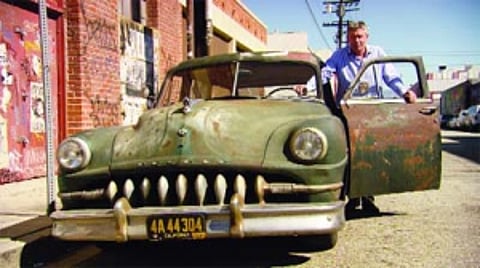

Former British racer and presenter of Fifth Gear, Timothy ‘Tiff’ Needell, is a walking encyclopaedia on automobiles. He talks to Karan Bhardwaj about the evolution of cars and his memories of winning the Bangalore Grand Prix in 1985
What kept you hooked with Fifth GearIJ
This time on Fifth Gear on Discovery Turbo, we are trying to expand more consumer side of things. We are concentrating on more of team tests where all four presenters — me, Jason, Jonny and Vicki, look at new cars and argue over them and agree with them and pick holes in them.
We’re doing more cheapskate alternatives, old second-hand cars that can give the same thrill as a modern car. We are doing more consumer advice and accident investigation. At the same time driving supercars and racing rally cars and going off-road to America to look at remodeling. So, we’re trying to bring more and more variety and enthusiasm to the car buyers. We want to bring to our viewers almost every aspect of motoring.
What is the latest development in automobiles that took you by surpriseIJ
The most impressive developments for me are the ones that improve road safety. First there was ABS (Anti-lock Braking) to stop us skidding and then there was ESP (Electronic Stability Programme) to stop us sliding and now there is AEB (Autonomous Emergency Braking) which slams the brakes on for you seconds before an impending impact. We’ve covered all of these in detail over the years and will continue to bring our viewers up to date on everything that helps them become safer road users.
What is the best car that you have drivenIJ
Few of my favourite cars will be a Mclaren F1 supercar which is an ultimate one. But driving any rear-wheel drive such a Porsche 911, a Ferrari or a BMW is when I have my fun. Though I am racer and prefer performance cars, but I like rear-wheel drive because I enjoy that feel of the steering. But the great thing about cars is it’s an individual choice. You know, what, even when we do our team tests, which are these items where all four of the presenters, we all look at a new car and then we all argue and we disagree. So, you know, what’s right for me is not right for someone else. We just like to guide people. We show people our choice but then of course, you have different things.
What drove you towards racingIJ
From the moment my father first took me to Goodwood there was only one thing I wanted to be — a racing driver. But later I went and completed my Civil Engineering degree. Soon, in the year 1975 I participated in the Formula Ford lotus 69F competition, where I won my first race. After that there was no looking back, I was determined to become a racing driver.
How do you look at the evolution of racingIJ
There is this huge change is electronics. For me, who is a traditionalist, there’s too much electronics involved in driving the car. If you look at my all-time favourite car, the Mclaren F1 supercar, where you sat in the middle; had a manual gear change and there was no power assistance to the steering. Where as something like a Bugatti Veyron, one doesn’t drive it, one operates it. It’s got 1,000 horsepower, but if you open the throttle in the corner you won’t have 1,000 horsepower because it will only give you 200 horsepower. It will only give you what the car thinks you should have. So there’s so much electronics, you know. It began — the very first thing was the fly-by-wire throttle, so even though you open the throttle on the Formula 1 car, the engine might decide — the computer says, ‘No, you can’t have that much power now, you can only have this much power.’ So, this and the gearbox is all — the paddle-shift instead of a manual — we’re going so electronic, so many computer brains and this is the huge change which makes the car safer for roads because the stability control, the anti-skid systems are amazing. But then when you want to drive the car as a driver, when you put all this protection on you don’t enjoy the driving feeling as much. I would also like to add one more thing that defines a racer nowadays is that they’re so fit, their mental concentration, reactions, balances. It’s a whole range of elements that goes into making the perfect racing driver. There’s no one thing.
How do you find new generation racersIJ
Nico Hulkenberg is on the top of most people’s lists to become the next new World Champion and I have to agree. The only problem is he’s too tall and therefore too heavy for the latest cars so top teams are in two minds as to whether to use him.
Daniel Ricciardo is an obvious candidate given his latest promotion to the Red Bull team but I have a feeling the Russian teenaged sensation Daniil Kvyat might be the biggest surprise!
What drives you crazyIJ Do you fearIJ
Whoa!! Now that opens a whole range of options — for starters, my sons leaving their towels on the bedroom floor and not hanging them up, now that drives me crazy — but I guess you mean in the motoring world. As a racing driver I never suffer from fear and don’t really believe you could be competitive if you did as you’d be unable to consistently drive right on the limit. Perhaps a little apprehension before a race and plenty of nervous tension but all that clears as soon as you leave the Pit lane.
Was fitness important back when you were racingIJ
It was important — but we just didn’t realise it! My Grand Prix chance coincided with the arrival of ‘ground effects’ and this massive increase in downforce saw cars generating far higher cornering forces than ever before and new muscles were suddenly needed — especially in the neck.
Before that we would do a bit of general fitness but it was generally felt that the only way to get fit for driving was to drive! You don’t have to go that far back to recall the likes of Senna and Mansell collapsing with exhaustion after races whereas nowadays with special fitness programmes and diets they look as fresh as when they started!
India has come a long way ever since you did Bangalore Grand Prix and the Madras Grand Prix. Share your Indian experience.
My trip to Bangalore and Madras was definitely some sort of time warp from a previous era! We raced up and down old broken up Second World War airfields and the only crash barriers were a few straw bales and the crowd itself! Thousands poured in to watch and many stood right on the edge of the track — actually stepping back if you ran a little wide. Now of course you have Irungattukottai, Kari and the Buddh Grand Prix track and it’s exciting to see regular single seater racing taking place at these tracks and hopefully grooming more Indian Grand Prix stars for the future. I haven’t been to any of these circuits but I hope this is something I will do one day soon — I have been away from India for too long.
Your association with Michael Schumacher. Anything you would like to say about himIJ
Unfortunately Michael is a generation beyond my racing years and I’ve had little direct contact with him. He is a genius behind the wheel and someone who is very much in our thoughts at this difficult time.