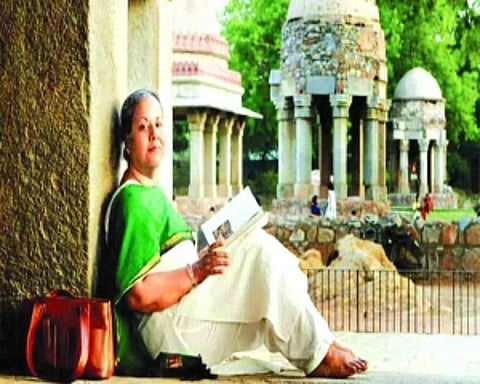

Writer and historian, Subhadra Sen Gupta, gives her admirers a final parting gift in the form of her posthumous work — The Story of the First Civilisations from Mesopotamia to the Aztecs. By Khushbu Kirti
‘Because None Has Survived. In Those Days The Best Stone’
Subhadra Sen Gupta (1952 – May 3, 2021), a beloved Indian writer and well-known historian, who lost the battle to Covid earlier this year, has given her admirers a final parting gift in the form of her last work — The Story of the First Civilisations from Mesopotamia to the Aztecs. The book is a thoroughly researched potent of historical facts for children. In her languid and lucid style of writing, Gupta has taken her readers on a final journey through the world of magical history. She has disseminated stories about the human origins and evolutionary elements in a manner most playful and intriguing.
Talking about what history means to her, in the most simplistic way, Gupta stated, “Soon we began to string words into sentences and then started to share information, express our emotions and also gossip. And today, everything from school to working in an office to sharing a recipe requires that we talk. This Cognitive Revolution began in our minds and this is what we call language.”
She continued, “The next stage was crucial because now we developed a written script and learnt to write everything down — and we haven’t stopped writing since. We kept records, wrote letters, printed books, and now we have WhatsApp and email.This was the first step to creating a history of people... Of kings and battles, gods and goddesses; what we ate and the clothes we wore; our songs and our games. It is all about our daily lives and the events of the world. And that, my friend, is what we call history.”
From engrossing facts of how Chinese civilisation were the first to introduce the concept of examinations, about Archimedes running naked through the streets yelling ‘Eureka’, and potatoes being a gift from Incas, legends of half-bull and half-man Minotaur and conspiracy theories around Atlantis, the book covers it all, from Mesopotamia to Aztecs. The book encompasses illustrations by Devashish Verma, embellishing the read.
The publisher of Talking Club, Sudeshna Shome Ghosh, who had put together the work, expressed, “It was a project that had thrilled and excited her (the author) and she had tackled it with her usual enthusiasm and meticulous research. As always, the writing here remained fresh, accessible, humorous — everything far removed from what one expects from history books. It was an honour and a huge responsibility for us to publish this book after her tragic demise earlier this year.”
Gupta wrote over 40 books for children as she thought that they were the best readers. The historian’s works are gracefully laced with facts from history that would entice all readers to peruse through stories in one sitting itself.
Some of her works include Goodbye Pasha Begum!, a horror story where the protagonist on a holiday in Delhi suddenly finds herself as a slave in the Mughal era, Bishnu - The Dhobi Singer about a dhobi boy who is supported by and taken under the tutelage of Tansen, A Mauryan Adventure where a daughter of a soldier in Ashoka’s army ventures around the world, and so on. Her book, Mystery of the House of Pigeons, was also adapted into a television series for Doordarshan as Khoj Khazana Khojher. She also gained popularity upon publishing The Constitution of India for Children, which she had attributed to a number of researchers, too. Her work Mahal: Power and Pageantry in the Mughal Harem revolved around the social life of a Mughal harem.
The winner of Sahitya Akademi’s 2015 Bal Sahitya Puraskar explored the genres of historical fiction and non-fiction, travelogues, detective tales, comic strips and ghost stories. In one of her most adored works, A Children’s History of India, she wrote, “a time when many great thinkers and philosophers emerged, all writing and debating their ideas. Most interestingly, people actually liked to listen to them! These scholars were also teachers or gurus and had schools called ashramas or gurukulas, where they taught students. Towns even had special assembly halls for debates called kautuhala shalas, that is, halls for arousing curiosity!”
Born in Delhi, Gupta had pursued her master’s degree in history. She had begun writing in college itself, working as a copywriter for advertising agencies.
In her book, The Unknown Indians: People Who Quietly Changed Our World, she imparts a lesson of life, “Being open to change, asking questions, being rebellious, being creative — that is how a civilisation grows and becomes like a huge banyan tree — giving shelter and shade to many people of many regions, languages, religions and gender.”