
Ten works of Ganesh Pyne, which will be showcased at the India Art Fair, revolve around his memories of Kolkata in the 1940s. By Uma Nair
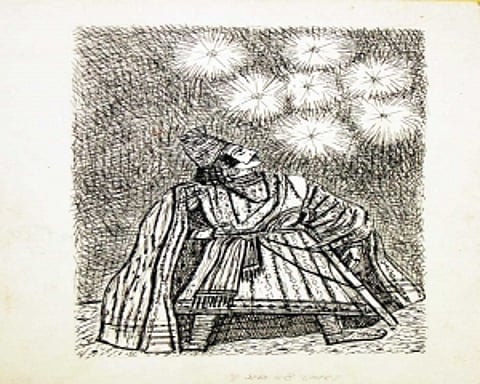
Recreating the anthologies written by iconic writers of Bengali literature, Kolkata-based Aakriti Art Gallery brings artist Ganesh Pyne’s 10 drawings to the year’s India Art Fair, setting a tone of ‘less is more’. He showcases the 1982 illustrations for Shotoborsher Roopkatha — 100 years of fairy tales. The authors include the Tagores to Ishwar Chandra Vidya Sagar to Sunil Gangopadhyay.
Romanticism and play of light
The 10 pen and ink works are not just about drawing but also the art of concealing rather than revealing. Pyne, the foremost exponent of the Bengal School of Art, was known for his ability to blend fantasy and romanticism along with an inventive play of light and dark. In Mone, we look at the labyrinths of the subconscious in the imagery of the young prince smelling the flowers. The expression of solitude and the narrative of simplicity both come together in the fine lithe detailing that he creates without being oppressive or overt.
Saat Bhai Champa
Pyne shapes his signature style of drawings with dulcet ease and effortlessness. The piece de resistance of the suite of works belongs to Saat Bhai Champa, the famous Bengali fairytale, which translates to Seven Champak flower brothers. Originally collected in the Thakurmar Jhuli (Grandmother’s Bag of Stories), it received a detailed update in 1944.
The King gazing at the seven flowers offers us a scent of the story and we can imagine him in his garden. The king’s robes, head dress, almond-shaped oriental eyes and the cross-hatching of the skies make us think of the sun leaning across its windows and sentient shadows nestling in its deep recesses, a spectacle of light and darkness enacted every day. As the king gazes at the seven flowers that finally become his seven sons, you can feel a hint of the radiation of a subtle magnetism. Pyne takes us back to the world of grandmother’s tales which stimulated the wide-eyed wonder of children.
Enchanting allure
Pori-ir Golpo is absolutely captivating for its compositional control and the strokes are as enchanting as the story. It makes one go back to the stories of how Pyne’s grandmother narrated tales to him on the verandah of his home during the evenings in the 1940s. Pyne’s imagination and sensitivity both come into play when you look closely at these drawings. It is said that as a result of listening to the stories, Pyne as a child artist was able to invent his own private mythology and familiar kingdom.
Questions come to our minds when we look at the drawings — What tales would a Bengali Hindu grandmother narrate in the early 1940s to her grandson? Epics, religious fables, folktales, and stories of valour and bravery and that of victory of the good over evil?
Pyne, the person
Essayist and critic Nanak Ganguly states, “Pyne’s fascination with the fables and mythology in various settings depict not only a reality but primeval values about what an artist chooses to look at and his strong and subliminal feelings about it.”
The beauty of these drawings is the fact that it gives us a window into the meticulous working of Pyne’s hand and mind as in Rajkumar Poncho and Maniraj. We are also compelled to recall that Pyne as a painter worked mostly in tempera. His paintings were rich in imagery and symbolism.
One also recalls Pyne talking about his early life in a crumbling Kolkata mansion, his evenings in smoky cafes discussing communism and Picasso with friends. “My childhood memories revolve around Kolkata. The sounds and smells of this city fill my being. I love Kolkata,” said Pyne in one of his exhibitions.
Solitude and structure
Pyne’s signature style has shaped from his own experiences of solitude, sight of sorrow, pathos of pain, heartened horror and tenderness and tranquility. At times, in these drawings, we see a minimalist resonance with poetic and lyrical annotations.
The contours and lines alternate between bold and soft, loose and controlled to give us a series that emerge in potency both in context and content. Stripped of colour, their monochromatic mood has about it an architectonic quality in the structuring of the imagery and the weaving in of the tale.
Equally enticing is the suggestion of his life’s leanings-we recall how Pyne had drawn inspiration from movies made by Fellini and Ingmar Bergman.This booth is bound to ensnare you in the ambience of nostalgia.
(The fair starts from January 30 to February 2.)