
A photo panel exhibition traces the major milestones achieved before the formation of the Japan-India Association in 1903. By Christy Varghese
The somber atmosphere of the basement of the Japan Foundation somehow seemed an appropriate environment for the photo panel exhibition on The History of Japan-India Exchange. The photographs displayed highlighted major milestones achieved in Indo-Japanese relations since before the formation of the Japan-India Association in 1903.
Misako Futsuki, Director of Arts and Cultural Exchange of the Japan Foundation, shared, “We believe that the audience will feel enriched about the significant milestones, which have strengthened ties between Japan and India over the centuries.” The photographs depicted important instances which form a close link between India and Japan. Futsuki also revealed that this exhibition was scheduled to commence in June to symbolise the Peace Treaty and the establishment of Diplomatic ties between Japan and India in June 1952 but was delayed due to some unavoidable reasons. “We faced some obstacles in getting the pictures here and setting up the exhibition,” he told us.
The Japanese have always regarded India with a certain reverence due to its credit as the birthplace of Buddhism, but the beginning of cultural exchanges and diplomatic ties of the past century sprang out of a simple economic deal
This was initiated by Jamsetji Tata, founder of the Tata group which happens to be India’s largest conglomerate company, when his visit to Japan in the 1880’s led to the Bombay Raw Cotton Contract (1893) which determined import-export details of cotton bales between Japan and India. Since then Japan and India have shared friendly relations for many years especially after the Peace Treaty was signed and the official diplomatic ties were established between the two countries in 1952.
The photographs depicted various luminaries who graced the people to people exchange between the two countries, but it is arguably Rabindranath Tagore who formed the strongest impression on the culturally rich Japanese. They respected him with a fervor shown only to major figures in their circle due to his immense credibility as a writer/poet and the mutual benevolence he had for the Japanese traditions.
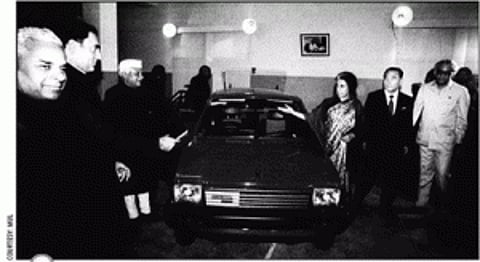
Various collaborative associations between the two countries were depicted but what really stood out was a photograph of Indira Gandhi at the factory of a joint venture between an Indian Public Sector Company (at that time), Maruti with Suzuki Motor Corporation of Japan to commence the production of small cars. Maruti Suzuki was the top runner in the passenger car market of India.
The success story of the Delhi metro has been an example for cities like Bangalore, Chennai, Kolkata and Mumbai which are currently developing their own rapid transit systems. But many people are not aware of the fact that the Government of Japan was a major benefactor of the Delhi Metro along with other major projects in India.
Interestingly, a surreal link between the two countries is Subhash Chandra Bose, whose ashes are carefully preserved in Renkoji Temple, Tokyo and every year in August, a memorial service is held.
And in the aftermath of the massive earthquake (of magnitude 9.0) that occurred off the Japanese coast on March 11, 2011 causing a powerful tsunami which generated widespread destruction, the then PM Manmohan Singh offered assistance of every manner to Japan. There were a series of exhibits depicting the Indian Relief and Rehabilitation Team deployed in the worst affected towns of Miyagi Prefecture by the Indian Ministry of External Affairs. The work was much appreciated by the people and Government of Japan.
The latest collaboration between Japan and India was in August last year, when Narendra Modi visited Japan. During the visit, Modi and his counterpart, Shinzo Abe, agreed to numerous strategic deals including Japan’s promise to give $35 billion to India through public and private funding over the next five years for developmental projects, apart from building of smart cities and assistance in the cleanup of Ganges.
Judging from the success shared in the past years, it is quite evident that Japan-India relations still have a good long way to go.