
The Iranian showcase at Dilli Haat is a tribute to shared craft heritage and traditions. By Unnati Joshi
With an aim of reviving old civilisational and creative links, Iranian craftspersons shared the platform with Indian artistes at Dilli Haat yesterday to weave the common threads of the famed carpet tradition. later they bonded over papier-mâché, calligraphy, enamelling and the most intricate paintings.
Iran is home to some of the richest art heritage. Art is a part of everyday life, permeating dishes, walls, clothes, panels and almost everything you can think of. Bright skies, blossoming spring and human figures dressed in splendid garments form the general themes of Iranian paintings.
The miniature painting tradition in Persia flourished from the 13th century and continues to this day, with several contemporary artists producing notable Persian miniatures. We met Kamran Baghban, whose visual commentary is so detailed that it is difficult to take your eyes away. “It takes about a month for me to complete a painting. The process begins with a thought. I shape that thought into a sketch. Then we colour it. Human figures are painted first, animals next and the background the last. Once the miniature is dry, we do the final touches.”
“Papier-mâché, which implies ‘chewed paper’ is composed of a combination of mashed paper pulp with reinforcements of textiles restrained with adhesives such as starch, gum or waste paper. The art of papier -mâché, was ushered into India during the Mughal dynasty and has retained its popularity even today,” said Niyaz, an artist from Srinagar.
Iranian artist Sharmin Saranj, who also works with enamel, told us, “If you pay attention to the architecture of the important Islamic places or tombs of important Muslims, you will probably see lots of meenakari on their walls, ceilings, and even chandeliers. Also, enamel works can be washed with lukewarm water, soap and even ordinary detergents.”
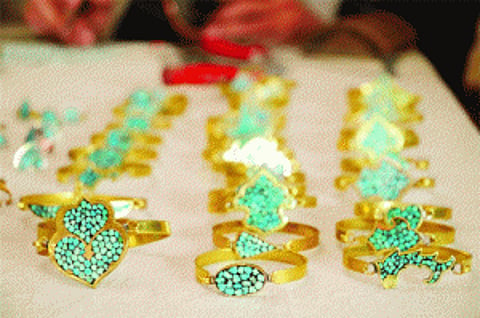
“History will tell you that many items of furniture and other everyday objects were made with papier-mâché. Many of these relics still exist today and are still hard enough to rap on with your knuckles. I work with brass and turquoise. My jewellery range from Rs500 to Rs1000 and above is appreciated everywhere. Even designer Rina Dhaka bought a ring from us today,” Bagher Nafari Valandani told us.
“We have been working with the block prints since ages. I am the tenth generation practitioner. I like constructing things and I am proud of my work. We work with cotton, silk and wool fabrics. The opportunity provided here has enabled many members to travel across the globe and collaborate with other artisans is remarkable,” Abdul Raza, a block printing artist from Gujarat said.
Dressed in a beautiful yellow organza ghagra and sequinned black hijab, we saw Ghamarolmolouk Setorg, a weaver from Shiraz, Iran. “My loom is of a kind that’s simple and easy to carry. Customer satisfaction is the top priority for me. If the customer isn’t satisfied then the job isn’t finished.”
Talking about the condition of women in Iran, she said, “We are very comfortable there. We are free to do whatever we want to. Except the hijab must be there.”
Textile is one area which has helped strengthen the ties between the two countries. “Considering that we are celebrating 60 years of India-Iran cultural ties that were renewed during your Prime Minister’s visit to Iran last year, I am sure the exhibition and the workshop of Iranian crafts will boost cooperation and trade. I think Iran is the first country which initiated a cultural cooperation with India after independence and it shows the importance of our historic link. The heritage of India and Iran has shaped the historical and national identity of the two countries. This rich and ancient heritage has many and varied manifestations. This art and handicraft, in addition to reflecting a part of valuable culture and heritage of the past and the present, also introduces the culture and civilisation of two countries as well as their economic development and employment opportunities,” said Gholamreza Ansari, an Iranian diplomat.
Organised by the Dastkari Haat Samiti, the fest brought together around 200 craftsmen from villages and towns all across India and Iran to showcase their super creative craftworks at a single stop.
“The aim of Dilli Haat was to help our rural artisans and craftsmen work with respect and dignity and sell directly without the middleman. From 2004 we began bringing craftpersons from other countries. We wanted to link the rest of the world with our craftspeople. There are around 200 craft persons, out of which nine are from Iran this time. We are proud to be carrying on the silk road history with Iran,” said Jaya Jaitley, founder, Dastkari Haat Samiti.
The cultural agreement promotes regular exchanges in arts, literature, poetry, language and other forms of cultural activity between the two countries (Iran and India.)
Fashion designer Rina Dhaka and crickter Ajay Jadeja were seen shopping at the exhibit.
The festival concludes on January 15. Photo:Pankaj Kumar