
The Delhi walk festival will give you the opportunity to step into the shoes of visually impaired people. By Mansi Bhansali
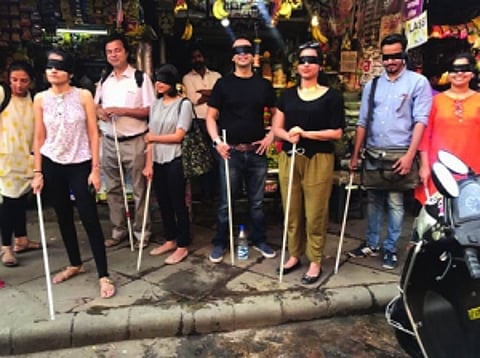
The walk through Khan Market will be led Baldev sir,” piped in one voice. Seemed like an ordinary walk which told you about the culture, history and unknown details about the areaIJ RightIJ But the twist in the tale was that Gulati, who led the walk was visually impaired. And this was the challenge. The main aim of the walk was to provide a sense of difficulties visually impaired people go through in their everyday life and to also further enhance our hearing, listening and smelling sensory organs. I was accompanied by few more people for the blind-folded walk at the Khan Market.
After two successful walks, Delhi Walk Festival will be coming up with its third edition which is being organised by Delhi, I love You and SAlT XP from November 2 to 12. The 170 walks within 11 days will be led by renowned walk experts (organisations and individuals), with an aim to generate curiosity for the lesser known, appreciation for the unfamiliar, nostalgia for the outgoing and new possibilities for the future Delhi. The one I attended was a preview which gave me a taste of what the walks would be like.
As soon as the blind fold was put on, I recall feeling scared and a feeling of irritation persisted around the eyes. I constantly kept adjusting the blindfold throughout the walk. While some people briefed us about the walk and what we could expect during it, others gave us the instructions on how to use the foldable stick to navigate. Each of us was given a guide to ensure we don’t bump into people, trees or be the cause of an accident.
For me, the walk was exceptional because I’ve never been to Khan Market so I was clueless about where I was heading to. Starting from the Khan Market metro station gate number 4 we all began our walk to Subramaniam Bharti Marg. During these 20 minutes I realised how blank a person can become when you can’t see which adds to the loss of sense of direction. While I was being guided through the path, I identified a cafe because of the aroma of coffee, juice shop and also scented candle shops. “Mansi, move towards your right, you are hitting a BMW,” said my guide and we both ended up laughing.
Most of the time he allowed me to navigate the area by myself, so that I could experience how tough and risky it is for a visually impaired person to conduct, what appears routine to us. Soon I completed the first phase of the challenge.
Gulati, is an optimistic and funny 45-year-old man who is full of life and zest. While for others, the stick was not much of a help as it just gave a vague idea about the obstacles in and around, but for him, the stick was very useful. Since all of us were moving, keeping an imaginative straight line in our heads, but in reality, it was unfortunately, completely incorrect. Gulati said this was nothing surprising. He pointed out, “It is difficult for a blind person to maintain a straight line. Until graduation, I didn’t use the stick but then I became awfully dependent on others, which made me use the stick to make myself mobile.” For him, walking through unfamiliar places or a road is a scary prospect. “I usually end up hurting my knees either because of the pillar or the pit-hole. This is why we slow down our pace in a new place,” said Gulati. He shared that there are some things which have made his life a little easier. He uses a voice-over to use his phone and the narrow tactile yellow line on the metro stations, which is to facilitate the movement of visually impaired people.
But being blindfolded was just the first part of the walk. The second phase involved role reversal — the reporters took on the role of guides and the PR persons were blind-folded. I felt this was the tougher part of the challenge. Helping a person who is dependent on you to navigate means that a constant fear races through your head that the person can go off-track. Reversing the role made me witness the reactions of people around. While some were astonished, others sympathised with the blind folded people and gave way along the roads and lanes. This made me remember why Gulati said, “I’ve more important things in life to focus and ponder upon rather than giving heed to useless comments.”
We successfully ended the second phase too. Gulati was keen to know about our experience. “I would like to take a pledge that whenever I’ll see any person with any sort of impairment I would definitely go and be useful in any way I could be to them not because I pity but to empower them,” shared one of the reporters.
For me, the blind fold was the eye opener.