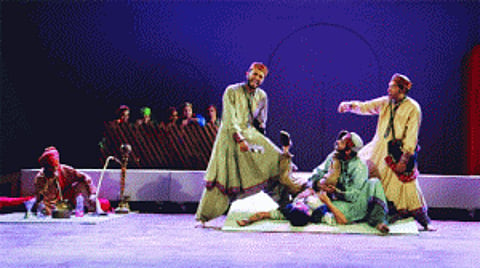

Theatre thespian Kamlaluddin Neelu’s rendition of Henrik Ibsen’s Peer Gynt, titled Native Peer, is a transcreation of the original and not merely a textual translation. The director tells Utpal K Banerjee that he has incorporated modern-day English lingo because of his actors
Peer Gynt, the iconic play penned in 1867 by the greatest 19th-century European playwright Henrik Ibsen, would, at one level, seem — while rooted into Scandinavian fairly tales, family experiences from parental lives and own 27-year sojourn in the continent away from home — mainly about a remote rustic boy, a braggart fatally attractive to women, a bogus poet, a narcissist, an absurd self-idolator, a liar, seducer and bombastic self-deceiver. Yet, chronicling Peer’s journey from the Norwegian mountains to the North African desert, the cinematic script blends poetry with social satire and realistic scenes with surreal ones. The irony of isolated individuals in a mass society infuses Ibsen’s tale with a superficial Peer, who is more a surface for projections than a coherent character. At this level, the play almost anticipates fragmentation of the emerging Modernism.
Native Peer, presented recently by NSD’s Final Year students under the baton of the thespian Kamlaluddin Neelu — also Norway-based at the moment — was able to capture the essentially fragmentary nature of the play: although built in epic proportions. We see Peer as the heir of a wealthy family, now left with no fame, but only with a doting mother Asha: irritated with his lies. Peer sets off to marry a rich girl Indrani, whose marriage was already fixed. Peer elopes with Indrani, only to desert her forthwith. Another girl Sarda has carved a niche in his heart. As abduction of Indrani was illegal, the outlawed Peer stays back in the rugged mountains. The King of Devils (Krolls in Norway) nearly forces him to marry his daughter as they had made love. Peer escapes the hurdle and, to encounter the descending winter, builds a hut on the hill-top. Sarda leaves home and vows to live with Peer who again departs —to see his mother back home, but reaches only to find her dead in a lonely hospital-bed.
Instead of returning to the mountains, Peer embarks on a long journey south. We see Peer now as a rich and successful business tycoon: with earnings by illegal means. In one of the parties in a Mumbai hotel, while sharing secrets about his success, he discloses his desire of becoming ‘emperor of the world.
We see Peer as a bedouin: recognised as a prophet, while wooing the princess Anitra; as a capitalist in an august company; and as an inmate in the mental asylum. Fate takes a new turn when he loses everything to become a pauper. He reaches his old village: with Sarda still waiting for him. The decrepit, ship-wrecked Peer now awaits death…
Native Peer waded through crests and troughs of the Ibsenian narrative and craftsmanship. It had a magical collage of visual images — running streams, overflowing dams, lush green meadows, et al. They were superbly supplemented by stage-props like peeping conduits, arc-like iron-bridges and eventually burning gateways to hell and awnings of a wrecked ship. Dramatic action went through very physical carrying of the mother over shoulder on long-distance treks; leaps and somersaults; and climbing often over treacherous cornices and crevices. The mid-auditorium ramp was used to the hilt for entries and exits. The only compromise made was with mountain heights: made up of flimsy wooden boxes and seemingly looking dizzy. Stylised acting went hand-in-hand with realistic sets of serving hard drinks and tango dances in a party, and board-meetings for vaunting grandiose corporate plans as well as personal braggings. What jarred were scenes with long, inept English dialogues by the enthusiastic cast who was so much more at home in their Hindi outpourings.
Extracts of interaction with the director:
How did you negotiate Ibsen’s textIJ
Though based on Ibsen’s text, my play is a transcreation, not merely textual translation, which I consider as a kind of laboratory work. The notion of making Native Peer is a re-investigation of inter-cultural theatre performance. This required a process of cultural adaptation of Ibsen’s text through negotiation with colonially mediated modernity.
Can you please explain your processIJ
Ibsen’s text is far from a satire on Norwegian egoticism, narrowness and self-sufficiency. The interesting feature of the play is that Peer Gynt — through his journey — is crossing borders and encountering different cultures. This makes a point of departure for re-examining the text within the frame of the socio-political conditions of the present-day India.
Yes, you bring in Mumbai …
I found the colonial Mumbai as the nearest equivalent of Ibsen’s visualisation of Morocco for this play’s events. You see, there is the fictional time and space on one side; and the physical time and space on another side for the play's configuration. The two needn’t be the same.
You have also created large flowing dams…
This is precisely to show Peer’s projected journey to modernity. Mine is a three-tier process beginning with local folk-level of reality. Then comes the level of an overwhelming modernity. Finally comes the return to self, the naked self-realisation, as you observe towards the end.
You have invoked English as the language for the modernity scenes…
My actors are from today’s background. Why can’t they use their common lingo while envisioning modernityIJ
Your mise en scene is a mix of total stylisation and stark realism…
I don’t believe in any essential distinction between the two. I blend them as per my dramatic needs.
Any other high pointsIJ
Apart from the socio-linguistic plurality, there are echoes of ethnicity-based cultural diversity, economic structure and power politics, caste and class inequalities, and especially gender inequality and sexual politics.