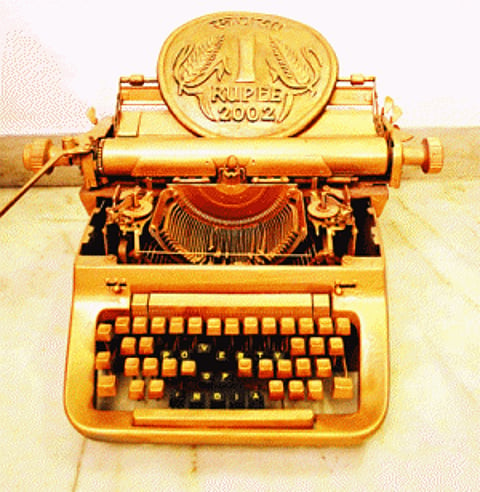

Saudamini Misra’s installations, made with objects like typewriter and kettle, are socio-political satires commenting on the role that power plays in our society. She speaks to Divya Kaushik
It is interesting to note how the humble kettle, mostly seen at street side tea stalls, has made its place in the art world. It has been invariably used as a symbol and as an object to display creativity in many exhibitions. Here again, the kettle is used as an important element to define power by artist Saudamini Misra. The artist uses the utensil as the harbinger of ‘achche din’.
The kettle signifies the rise of Narendra Modi from being the common man to the national icon today. She says, “Narendra Modi’s journey, from being a chaiwala to a national icon carrying the promise of better times, inspired this sculpture. The kettle is an indispensable icon of Indian household that goes beyond the class strata. Rich, poor or middle class, the kettle is part of everyone’s life. Tea is the catalyst that brings people together while memories are created and decisions are taken over the drink, good or bad. The little clock that you see in the front of the kettle signifies memories, progression and transition. It also stands for the promise of ‘achche din.’”
The self-taught artist based in Delhi earlier drew inspiration from her own experiences for her paintings and installations and, therefore, most of her works were semi-autobiographical. later, she realised that her observations and experiences are similar to many others. Whatever she thinks affects her, affects others, too. Therefore, she moved on to describe social situations and issues particularly from her own city. Now her works are a social satire and commentary on people’s attitude, corruption and political situations among many other things.
In her present series of installations, she defines the role of power in our life and society. One of her installations is a typewriter with letters ‘poverty of India’ highlighted in black. Misra explains, “This is a commentary on Indian authors who capitalise on the poverty of India by making it their ‘original’ subject in order to win international acclaim. The irony is that the so called Indian author himself belongs to that privileged strata of Indian society where his financial well being allows him the time and luxury to write.
These authors, in a way, use the poverty of India to glorify their works. The coin that one can see in the installation stands for the fame and money that these authors receive.” The other installation is The Wooden Airplanes that reflects the growth of the country’s economy and bilateral trade which is paramount. Hence, the artist’s planes are full of currency patterns (the US dollar and the Indian rupee), which possess a narrative of their own.
“It is symbolic of the global economic nexus which is now becoming all the more conspicuous with the formation of the new government,” says the artist. Keeping in mind the upturn of political events in Delhi with Arvind Kejriwal as the new CM of Delhi, Misra has already started working on the topic of “lal batti culture.” Misra says that the red light has been used to define the power battles in Delhi. “It seems that only those can survive, who have the power today.
I am not talking about any political scenario here, but I want to highlight how this role that power plays in our society has started to affect everyone. It seems everyone needs some connection with the ‘powerful’ to attain something. Since making Delhi free of this ‘lal batti culture’ is one of the prime agendas of Kejriwal, I have conceptualised an entire series based on this. I am planning to come up with art works that will use the red light in the most unlikely places. For example, people going for lal batti dinners instead of candle light dinners where they are served a plate full of money instead of food to signify that if you have the power, you have the money,” says Misra.