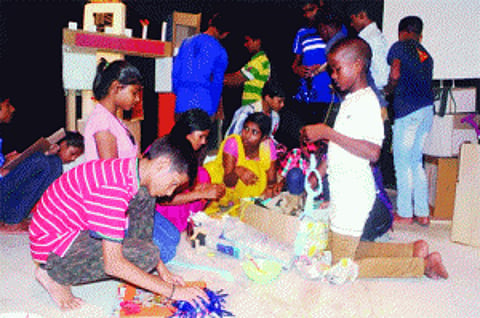

In a room in one of the galleries of the National Museum, six-year-old Kritika Singh poured over three bottles of paint, trying to add colour to a butterfly. Next to her, nine-year-old Nishant Raina busied himself with some pencil shavings using it to make a face of a Japanese man, “like the one I saw on the Internet.” All around them, on the walls were other artworks which ranged from paintings to a replica of a tin-man and a bug made from coloured paper to a simple pencil sketch of a village.
Called the art room, it is the first stop for kids at the ongoing live exhibition at the museum called Elements. It is a unique attempt by the museum in collaboration with Think Arts to familiarise the younger generation the sense of smell, touch, taste, sound and vision. The exhibition is live in the sense that children can touch objects, taste samples of spices, smell different elements like camphor and incense, hear the sound of instruments made from unconventional materials and walk on textures like dry leaves, grass, cotton and pebbles.
The thought behind putting together this exhibition came to Ruchira Das when she realised that the young generation today does not identify with the simple joys of creativity. “Most of their time is spent either staring at the television or playing games on the phone. Their tactile world shrinks the moment they enter school. They do not go out and play in parks and are always under pressure to follow what they are told. There is no room for their own imagination,” said the founder of Think Arts. The exhibition is an attempt to give the children a creative space and wide tactile environment.
The art room, Ruchira explains, is a means to ease a kid into the creative world that await them. She explained that it was first called the cupboard room but later changed to the art room. There is a reason that it is right in the beginning, she said. “They come in from a rushed environment and are not able to pay attention to minute details. letting their imagination run wild and free and the whole act of exploring slowly zones them into the process,” she added.
Immediately after the art room, the children enter another room with a huge chest of drawers. It is for every child to explore. In one of them, one will find a miniature replica of a Victorian household set and in another one will find a tiny version of a departmental store with a toy cart. Interestingly, the products are all real — detergent sachet, pocket sized powder bottles and shampoos and tiny Tic Tac boxes.
Amidst the many drawers and panels of cupboard, there are three drawers which test the guessing a child’s ability to identify things based on taste, smell and touch. In one of the drawers are three different spices which one can taste and identify and another where one can smell and identify. Jain quickly pointed out that it is not necessary for kids to open all drawers. “The whole point of this exhibition is to let them do what they want,” she pointed out. We found Kritika fiddling with the lights of a small replica of a theatre stage. She seemed to be having fun, making one stage light stronger and dimming the other one. Das explained that it is through quirky activities that a child's imagination widens.
One of the panels of the entire set up leads to a labyrinth — a maze through which a child has to find his way out. The purpose of the maze, Jain told us later, is to infuse a fun element. The kids ran about giggling in joy, trying to find their way out, which is through a narrow tunnel. At the end of the tunnel is the music room, curated by musician Rajat Mallick. Apart from the usual wind chimes and the congo, there were a range of musical instruments that Mallick created from objects found in and around the house. The most interesting is the storm drum, made by suspending spring from the bottom of a half cut harpic bottle. There are shakers, a xylophone and rain sticks which sounds like rainfall when hit against a soft surface. Jain said that the room familiaries a child with the different kind of sounds that they can make and create with even the simplest of objects.
The last stop of the exhibition is the textured walk where every kid has to step on a series of boxed with different materials. It is an attempt to give the kids a feel of what it’s like to walk barefoot on elements like coloured powder, sand, wood shrapnel and sponge. “Kids nowadays do not know the joys of walking barefoot. This gives them an opportunity to experience that,” said Das