
Being the melting pot of several ethnic groups and a juncture of different communities across the border, the Himalayas are a repository of tales. The ongoing exhibition at IIC highlights them. By Trisha Mukherjee
Personified sometimes as the devi or a demoness and at other times quantified as heaven, the legends associated with the magnificent Himalayas only diversify as you move across the range. Much like they curve over the sub-continent, they also dominate the imagination of the ethnic groups inhabiting the mountains and giving rise to a plethora of intriguing tales.
The Himalaya: a Timeless Quest, an ongoing exhibition at India International Centre focuses on the mountain range through the prism of mythology and literature. The cult of the devi has had a distinguished history in the western-central Himalaya as the great goddess of normative Hinduism manifests in local forms; sometimes as the domestic goddess, Nanda Devi, and at other times the demonic Hadimba Devi. “In Uttarakhand and Himachal, devi, the quintessential female power, reigns supreme even as the enigmatic lord Shiva meditates to the north at Kailash. Since times immemorial, the devout have come here for the absolution of their sins while sages meditated as they sought salvation,” says Dev Mukharji, the curator of the exhibition.
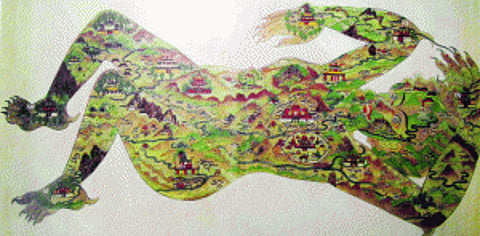
Although the Himalayas protect India from the freezing winds coming from the north, it was never a wall of separation, for Tibet has a story of its own to tell. legend has it that during the reign of their first Dharmaraja (reigned 617-650), the country was believed to be a supine demoness who lay sprawled across the Himalaya, with one limb in Bhutan and the other in western Tibet.
“She was apparently prone to sudden and violent movements and was unwelcoming of Buddhism. To end the misery of his subjects, the king mapped the form of the demoness and then constructed temples at key locations above the principal organs and joints,” informs Mukharji.
The Hindu epic Mahabharata, couldn’t have dispatched its final moral lesson, had it not been for the magnificent Himalayas which have been referred to as heaven. The epic culminates with an interesting story where the mortal bodies of all the pandavas except Yudhisthir perish on their way to heaven. As he continues his journey alone followed religiously by a dog, he is asked by Indra to ascend the chariot sent from heaven. “And Yudhisthir looked around and said to his dog, ‘get into the chariot child.’ The God stood aghast,” narrates Mukharji. As the Dharmaraj refused to get into the chariot without the dog, it immediately revealed itself as Dharma. “Then Yudhisthir, with Indra, Dharma and other gods, proceeds to heaven in the celestial car. He meets his brothers who are now immortals, and all at last is bliss,” adds Mukharji.
The north east legends associated with the Himalaya are extremely fascinating as they tell the story of the beginning of the world. According to the Minyong legend of Arunachal Pradesh, the earth (Sedi) and sky (Melo) are husband and wife, and their union was so close that there was no room for mankind to live. “But, when the mithun (Gaur) was born and wandered over the hills. His horns hit the clouds and in anger, he tossed them away, far above the earth,” Mukharji quotes from the legend. Agonised by the separation, Sedi desired to get back to the clouds, but the sun and the moon came in her way and she was compelled to retreat. “That part of her which was reaching towards her lord, the sky, became fixed forever as the great mountains,” says Mukharji.
Being the melting pot of several ethnic groups and a juncture of different communities across the border, the Himalayas are opulent with such tales from different regions and religions. The exhibition which will continue till July 23 will let you have a dekko at its diversity.
