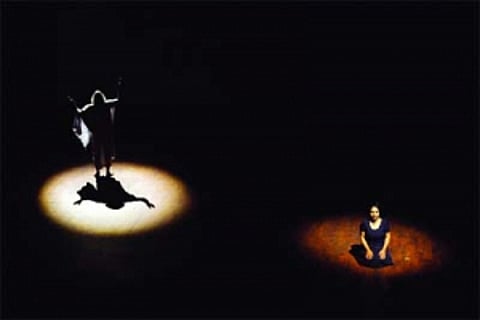

Raj Bisaria talks to Utpal K Banerjee about his adaptaion of Maxwell Anderson’s Barefoot in Athens and how it describes democracy
Barefoot in Athens (1951) was originally penned as a play by Maxwell Anderson (1888-1959): an American playwright, poet, journalist and lyricist. Interestingly, it has never been noticed that the play’s action — concerning the trial and last days of Greece’s most famous polemical philosopher Socrates — in many ways reflected the querulous turmoil in Anderson’s own life. When he became the principal of a high school in North Dakota and taught English, he was first fired for making pacifist statements to his students. Moving west to Palo Alto, he wrote for a newspaper but was again fired for writing an editorial, stating that it would be impossible for Germany to pay off its war-debt. So he moved to San Francisco to join San Francisco Chronicle to be fired yet again for missing work. Back in the east coast, he covered politics in New Republic, fired finally for quarrelling with the editor-in-chief.
Anderson’s play, nonetheless, went on to become an Emmy-award winning television-film in 1966 and later was carried to the celluloid with a star-cast of Peter Ustinov as Socrates, Geraldine Page as wife Xantippe and Anthony Quale as the cameo-king of Sparta. Ustinov won an Emmy award for the protagonist’s role.
Sukrat Nange Paon, presented in Hindi by Taw from lucknow, was a faithful adaptation from Barefoot in Athens. Under the baton of the acknowledged thespian Raj Bisaria — who had earlier handled classics of Shakespeare and Chekhov, besides modern plays of Pinter and Strindberg — the play sported the best cast from the Hindi hinterland, with the wise Socrates (Suryamohan Kulshrestha) and the Spartan king Pausanias (Jugal Kishore) both enacted very well. Calling himself a fool, the king had a staccato mode of articulation: a theatrical tour de force!
The play begins placing the absent-minded master in intimate family setting: surrounded by an infinitely compassionate Xantippe and three children rearing to rush into the world. Soon Socrates is embroiled for “false” teachings; charged for corrupting the youth and treason against the state and arrested with shackles around feet. The Athenian nobility is unable to stand the teacher’s steadfast stand for truth. Notwithstanding the disciples’ defence, Socrates is presented before the city’s jury and — by slender margin of vote — sentenced to death by drinking hemlock. There are charming scenes involving Spartan king’s endeavour to abduct the philosopher and secure him to his own capital. The stunning climax is worked out on one of the greatest trails in the world-history where Socrates places his commitment to truth above any worship of divinity and sets forth his deep faith in democracy.
Excepts from an interview with the director:
Why did you choose this play for today’s audienceIJ
let’s face a few facts. One, Socrates appeared nearly three millennia back as the first prophet with a clear commitment for democracy. Democracy was not invented in recent times. It was Greece’s gift to civilisation. Two, he was the West’s first martyr for his unshakeable faith in the cause of truth. Three, education existed at a premium level and was certainly not available to the hoi polloi. Socrates’ dialogical method was a pioneering and systematic effort to spread education. Four, Socratic discourses on ethics — as first of their kind — were trendsetters. These facts are relevant for the masses even today.
How did you come across Anderson’s textIJ
I came to know about it in the 1950s when it was written and saw it when it was performed on television. I was immediately taken in. In my own small way, I have always been a seeker for truth. I obtained the original script and paid duly for the royalty to perform it in India.
Your actors for Socrates and the Spartan king are well chosen…
Both Kulshreshtha and Jugal Kishore are theatre directors and not actors. Kulshreshtha has acted after a gap of 25 years. For Jugal Kishore, the Spartan king — who treats himself as a buffoon — needed a distinctive mannerism. As stammering is not ethical, we developed a special style! They’re all my students.
You’ve paid special attention on Socrates’ family…
We have treated the wife and sons of the philosopher in an original manner. Xantippe is seen to be someone more than what the shrew tradition has made of her. She realises she has a tender husband and has real understanding for the principles for which he gave up his life.
How about the costume for the characters and the stage-propsIJ
We have researched on costume and obtained authentic material on the Greek robes of those times. Regarding our furniture, they are authentic. We couldn’t bring our specially-made furniture from lucknow but have worked with the next best.
What about musicIJ
Though old musical instruments are extant, no Greek music has survived from the ancient times. We went for the Ukrainian music, which resembles Greek music a lot. We invited from Delhi the gifted musician Kajal Ghosh who did a marvellous job.