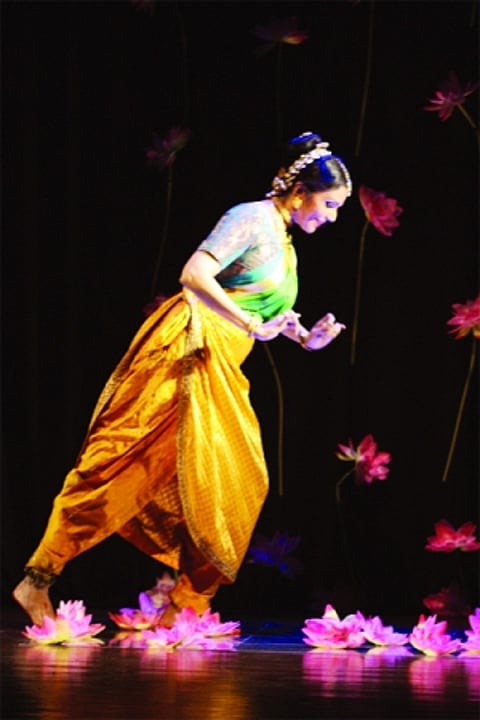

Danseuse Anita Ratnam tells Utpal K Banerjee that her production Neelam is billed as Neo-Bharatanatyam as she uses Mohiniyattam and Kathakali in her choreography
Spirituality in India — even in the early times — had seldom remained confined to the solitary meditation in the remote caves, bereft of animate company. Over and beyond the noble souls rapt in contemplation in the faraway Himalayas, the worship of the Supreme and the obeisance to the divinity were quite often offered through melodious vocal sounds and sinuous gestures of the human physique: quite literally in the form of song and dance. In fact, when the first bhakti (devotion) movement blossomed in the south India around the sixth-seventh century, its first torchbearers were the Azhwar (pronounced Arayer) priests who sang, chanted and performed before their chosen deities in various temples. The movement spread like wild fire — crossing all barriers of caste, creed and community — in the subsequent centuries and engulfed rest of the sub continent with their retinue of itinerant poets and preachers, dancers and storytellers, and these torch-bearers always performed before an enchanted audience.
Neelam-Drowning in Bliss, conceived, choreographed and performed by the Bharatanatyam danseuse, Anita Ratnam from Chennai, was presented recently as “a solo psalm of music and movement painted in the many hues of the skies and ocean, praising and adoring the lord Narayana.” Indeed, Narayana (Vishnu) was the chosen God for the Azhwar priests, before Shiva or other divinities began being revered en masse in later times, going to the extent of seeking simply “man of the soul” (Maner Manush) by Bauls in the East.
People from south of the Vindhyas pay perhaps more attention to their traditions than their northern counterparts and Anita spanned her spiritual journey — across centuries — beginning aptly with a small temple-town in Tamil Nadu, where the social reformer Ramanuja once came and rested. According to legends, Vishnu appeared as a mendicant student to test his devotion, obtained the eight-syllable seed-chant: Om Namo Narayanaya and ended by revealing himself as Naada Vinodana (aesthete of music and dance). Anita’s depiction of this episode was as a vivid varnam, punctuated by distinctive nadai (gait) of ritual dancers who accompany the temple-chariot carrying the lord on shouldered palanquin.
Down the historical time, Andal-the chant of Gora came next as a perfect padam. Some 600 years before Queen Mirabai, Andal was found in a tulsi bush, was nurtured by a temple-priest and had ruled the heart of Vishnu: whom she worshipped daily with a flower-garland at the temple. Among many saint-poetesses of India, Andal is the only one elevated to the status of a Goddess and this is how her sensuous poem on Panchajanya, Krishna’s battle-conch, concludes on the stage:
Mere mortals like me have to bathe, but you’re so fortunate,
You bathe in the moisture of my Krishna’s lips,
Are you not my friend, dear conchIJ See, I too am wearing conch bangles, So please tell me, dear conch, how do my Krishna’s lips taste:
like camphor or the nectar of lotusesIJ
The penultimate piece, lakshmi-the Radiant lotus, was about many aspects of goddess lakshmi: the benefactor, the warrior, the wisdom-carrier, the brave one, the protector of children and the light of our homes. Based on a Telugu composition by the 16th century Annamacharya in raga Kurunji, this was another padam arranged unusually on piano. The finale was Neelam-the valiant Rama, for the 18th-century composition of Muthuswamy Dikshiter. If the initial Vishnu hymn was sheer adoration, Andal was adulation, lakshmi was admiration and Rama was an adumbration that outlined the story of Rama through a sound-design: drawing upon the Carnatic music tradition of ragam, tanam and pallavi.
Excerpts from an interview with Anita Ratnam:
Having been a non-traditional performer all along, how have you returned to traditionIJ
Neelam was created as a new work on the first anniversary of MS Subbulakshmi eight years ago. She had made Dikshitar’s iconic Rama composition famous by always having it in her concert-repertoire. It was at her instance that I — as a teenager — debuted this song in her music academy performance in 1971. So here it’s a journey down the memory lane, not return to tradition. Otherwise, my works like Tara — showcased at IIC — was about that Buddhist deity common the world over and Abani — staged at NSD festival — was a collage from Tagore.
Why is Neelam billed as Neo-BharatanatyamIJ
I don’t do pure Bharatanatyam in my productions but mix it with other styles if need be. Here, for instance, you’ll find Mohiniyattam in lakshmi and Kathakali in Rama in the bow-lifting scene. I’ve seriously learnt these forms when I was 17 and have given solo performances on stage in those styles.
Neelam’s costume seems to reflect male-female blending…
Yes, androgynous tensions are inherent in the bhakti literature of south India. My adornment neck upwards is the usual female, but neck downwards, I wear the male dhoti. The bhakti icons dress this way because of their belief that only Krishna is male, the rest of the humanity is female!
Your music is both complex and rich….
All my creations take a year or so, where I pay a lot of attention to music. They are well-detailed and performed by concert musicians.