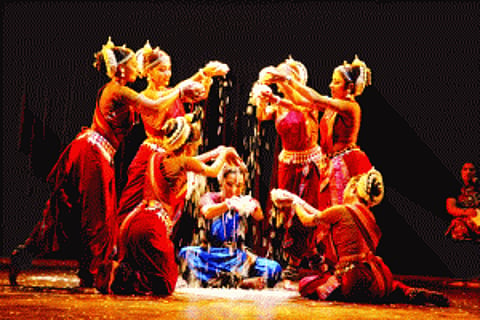

It's more apt to call Odissi danseuse Sharmila Biswas a non conformist with a traditional mooring. In a bid to find the grains of human elements in dancing she even cherishes to see dancers making mistakes on stage. Her Chaturvidh-Four Dances at A Festival of The Arts, was a glimpse on her talent and philosophy. By Saritha Saraswathy Balan
Sharmila Biswas accentuates her speech through gestures. In that way her off-stage life is an extension of her on-stage persona. Ingenuity is one of her traits and the accent and the slang that she uses possess a rustic, rural charm. When it comes to dancing, she is open to innovations. An artiste with strong notions she choreographs performances that speak for her cause.
She presented Chaturvidh: Four Dances in the Odishi Marga at A Festival of The Arts progressing at India International Centre which , in a way, is an attempt to conserve the temple tradition of Odisha. The presentation has four parts and the first one is invocation, Devi Bharani, traditionally performed during Dussehra in the Sambaleswari temple, Odisha. It means invoking the spirit of Devi, the goddess, into the body of the devotee.
The second part is Abartan-Bibartan. It’s a puritan format of Odissi dance. Abartan is a cycle whereas Bibartan is an evolution. Abartan changes into different flavours. Biswas has used the tala traditions of Odisha in it. “Using this technique I have created a game between Abartan and Vibartan. It’s playful as well as challenging. There is an energetic expression and drama behind each tala. It’s really challenging for the dancers as it needs a lot of improvisation on stage,” Biswas says.
The third part of Chaturvidh is Yashoda‘s Story. In this the dancers are story tellers. Abhinay —art of expression — takes it into a different level. “The audience after the pure dance wants to see into the depth. It’s a journey which you have to enter into and a tribute to Kalanidhi Narayan who has taught me Abhinay”, she explains. In this part Yashodha tells the story of Rama to infant Krishna not knowing he is an incarnation of Rama. “Yashodha story is the one which only a mother can tell. There are moments in this which have a lot of scope for dramatisation. The vatsalya rasa (affection) in it can beautifully create dramatic movements as well as evoke deep emotion of a mother to which the audience can easily relate to. One story can be interpreted in different ways,” she says, revealing her preference of Yashodha in Ramayana over others.
The fourth and the final part is Murchhana. Biswas chose Murchhana as it is based on the Odishi mrudanga tradition and dance. The festival this year has a special focus on Bengal and Biswas, from Bengal, says that in each state of the country there is a lot to explore. She also feels that the distinct artistic culture of each state should be well presented and preserved.
But on collaboration or fusion she has her own thoughts. While believing that through collaboration one gets to know other art forms as well she fears that sometimes you never go deep into one subject. “Collaboration would bring out momentary excitement, but at the end what we should bring out of it is important. It may not be mindless for those who are doing but I feel very impatient with it. It has to have a purpose,” she opens up.
A disciple of guru Kelucharan Mohapatra. she has been collaborating with the traditional Mrudanga of Odisha for long. “This kind of collaboration interests me. There is a kind of strengthening happening in it. We are going into the roots in it. It also gives the artists, who relate with the instrument, a special power and kind of enrichment works out. They become strong and totally focused. They need a special kind of support and artistes in the mainstream should work for that,” she says.
In the case of temple rituals, like Devi Bharani, also there should be pro active step from the village authorities to conserve them. “What I can do is to just take it to the stage,” she feels.
The obsession of Biswas, who founded Odishi Vision and Movement, now is to develop a curriculum for dance that even teaches how to speak, sing and play in rhythm. “After all dance is a very composite art. Only the face, the mask, of dance comes on stage. It should be learned in depth,” she says.
Aided by her vast experience and talent, Biswas takes a different look at dancing. She finds dancing as a very personal affair and likes to see the human elements clearly interwoven into it. This philosophy makes her love dancing more when the dancers make mistakes on stage. “I love it. I love to see them even falling. The audience laugh at that and the dancers start again. That’s how the audience and dancer become one. Dancing should be personal,” she laughs.