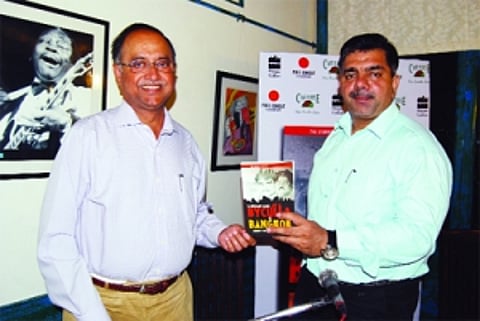

Hussain Zaidi's Byculla to Bangkok deals with three of the mobsters of Mumbai — Chota Rajan, Arun Gawli and Ashwin Naik. The author tells Karan Bhardwaj how the underworld is still active through real estate and the film industry
Expect some fireworks when a top cop and a veteran scribe (crime) share the dais to discuss mafias and underworld which overshadowed the city of Mumbai for more than two decades, primarily 80s and 90s. At the launch of Byculla to Bangkok, its author Hussain Zaidi conversed with Delhi’s former police commissioner Neeraj Kumar, and exchanged interesting anecdotes that the two gathered after working actively for years. The book is a sequel to Zaidi’s Dongri To Dubai and deals with three of the mobsters of Mumbai, Chota Rajan, Arun Gawli and Ashwin Naik. “In Mumbai, mafias could have perished in 70s only. Unfortunately, the city police was clueless about the Pathan mafias, who were reigning in 40s, 50s and so on. These goons were absolutely lawless. If they come to police stations, they would break chairs and tables if the cop is out on patrolling. Fed up by the uncontrollable ruckus, police created the Dawood gang to eliminate pathanis. Dawood got ambitious and wanted to rule over Mumbai and political system,” said Zaidi, who has also authored Mafia Queens of Mumbai and Black Friday. One wonders why Mumbai attracted the underworld and not other metros like Bangalore and Delhi. “Ants always reach the sugar. Mumbai is the financial capital and has world’s largest film industry. So gangster wanted to grab the land of opportunities. Bangalore and Chennai too had mafias. But to flourish in any city, they need to know how to manipulate the system. That’s the reason why even D-company couldn’t sustain for very long,” said Zaidi as he was immediately interrupted by Kumar, who brought up the contribution of police in diffusing the sagas of blood and gore.
The author also questioned the riches of encounter specialists in the system. He shared how Dawood created the concept of ‘encounters’. “The gangster realised that he couldn’t finish all his rivals by himself. So he maneuvered encounters. While Mumbai police was taking pride in gunning down goons, little did they know that they were killing Dawood’s rivals. The game of encounters itself became an industry which is why most of the encounter-specialists are billionaires today. They minted money out of this business since there are a handful of such specialists,” said the author, who has spoken to Dawood Ibrahim twice over phone and also published his last interview to any scribe.
Is underworld still active in Mumbai or drowned with timeIJ “They are still there but the modus operandi has changed. Now they try to instill fear more than killing. They would break windows or shoot at cars. Most of them have slipped into real estate business and Bollywood,” he said as he further illustrated, “Why do you think Sanjay Dutt acted in Chatur Singh Two Star after reclaiming his career with Munnabhai MBBSIJ The movie was produced by Mohammad Aslam, who is very much known for his affinity for the D-company. Dutt did the film in pressure while Aslam easily garnered Rs 30 crore out of it.”
Neeraj Kumar grilled the author for excluding Manish lala in his book, who was said to be the ‘law minister’ of the D-company. To which Zaidi accepted his bias by saying, “He was a dear friend and was never convicted in any case. I have a soft corner for lala.”
Kumar also shared an anecdote regarding lala. “While I was in CBI, I was chasing lala. He called and asked ‘why do you want me sirIJ I have done no wrong.’ He said he would not oppose his custody and eventually got arrested. During interrogations, I realised his intelligence. He also shared why he agreed for his custody. He told me, ‘I have met several police officers. But only you offered me a seat.’ Eventually, he got free of all the cases,” he said.
Will Dawood ever be nabbedIJ “If Osama Bin laden can be killed, how difficult is it to catch DawoodIJ But it requires determination like US. In fact, we had a plan to nab him which was dropped at the last minute by the political system. I don’t see it happening,” Kumar lamented. While he praised crime reporters, who maintain the documentation and continuity of city’s criminal records, Zaidi assured he never stepped out of his journalism domain to interfere into the functioning of mafias or police.