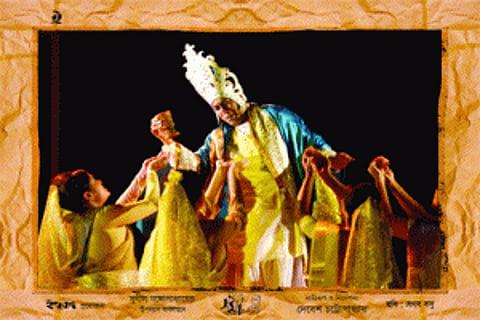

Nihsanga Samrat, directed by Debesh Chattopadhyay, is a saga of the life and times of Sisir Kumar Bhaduri, who became a legend for the current generation, says Utpal K Banerjee
Sisir Kumar Bhaduri (1889-1959) was a towering figure in the early 20th century. He established reputation as an actor while still at university, playing the lead-role in Tagore’s play Baikunther Khata (1912). While serving as lecturer in English at Vidyasagar College (1914-21), he created sensation in his first professional theatre appearance in title role of the landmark Bengali play, Alamgir, produced by the pioneering Madan Theatre (1921). He established his own theatre company, Natyamandir (1923), with Jogesh Choudhury’s Seeta: a play re-defining conventional mythology with greater emphasis on dramatically-coherent performance-idiom; elimination of stage wings and orchestra-pit; and new kind of background music in harmony with songs of the blind maestro KC Dey, who in turn bequeathed a musical legacy to nephew Manna Dey.
Bhaduri’s best known productions included re-edited traditional plays, influential stage interpretations of Tagore and — at the Srirangam theatre (1942-56) — plays comprising new-generation writing like Duhkhir Iman and Takht-e-Taus. As participant in cultural anti-Fascist front, he was among the few commercial-theatre personalities acknowledged by the Indian Peoples Theatre Association (IPTA). Bhaduri’s theatre hosted the IPTA’s revolutionary inaugural production, Nabanna (1943).
Nihsanga Samrat (The lonely Monarch), presented in Bengali by Paikpara Indranranga from Kolkata at the NSD Bharat Rang Mahotav, is a saga of the life and times of Bhaduri who became a legend for the current generation. The play presents a collage of various aspects of his life, on and off the stage, with many of his plays revisited in the context of his personal life. It is a salutary effort to look at the legend as a human being: unveiling the near- mythical anecdotes about him. He was a majestic man who could decline the Padma Bhushan with nonchalance; who lived only with the aim of fulfilling his lifelong dream to create the Institution of National Theatre but in vain; who could rebuff the conventional route to success in his quest for a unique format of Indian theatre, which would be independent of the British dramatic parameters as prevalent then, and who could draw inspiration from folk-idioms. The play does ample justice to Bhaduri (essayed by Debshankar Halder with great panache): his many inter-personal relationships, especially with still-living Saumitra Chatterje who eagerly learnt from him, and his tenderness for women including Kadambari who became the latter-life companion to the widower Bhaduri. The use of a phalange of chorus, reminiscent of the Greek tradition for music and dance, and the actors themselves arranging and re-arranging stage-props are quite innovative.
Excerpts from an interview with director Debesh Chattopadhyay.
Your play is said to be based on the noted litterateur Sunil Gangopadyay’s novel…
Yes, but I have not followed the novel’s text in toto. The dramatic version is very different in structure. I have included many action-scenes from plays written and directed by Bhaduri. This makes it far more presentable to spectators.
How about Bhaduri’s distinctive and very famous acting styleIJ
I didn’t have the chance to see him act in my time, nor is there any recordings of his acting on stage. But there are audio recordings available. Instead of trying to attempt and imitate his acting prowess, my approach has been to provide the text of his old plays to my dramatis personae, including the lead-actor and urge them to interpret the same in contemporary style, keeping Bhaduri’s flavour in tact.
How about musicIJ
Melodies tiptoe into my thoughts and integrate with my visualisation and literally seep into my composition. As a result, mine is almost a musical play! I have kept parts of the old-time music and used Rabindra Sangeet (Tagore songs) copiously. Bhaduri was very fond of Tagore’s music.
Your light effects are quite striking…
lights, in their hues, angles and intensities, have illuminated two different strata to create different dimensions and have sometimes merged into a single entity.