
The contemporary art scene in the country has evolved and has an immense global presence. The 12th edition of India Art Fair is the right place to discover its reach. By Team Viva
Art that captures the imagination is often that which serves a witness to and a reflection of contemporary times. The populist sentiments against migration being voiced by many of the political parties has naturally found a reaction at the latest edition of the India Art Fair. There is a migration series — You Will Know Me, curated by Tara Sabharwal by The Art Alive Gallery. The works are about the artists who have migrated to the US and Germany. There are stories around artist like Vir Munshi on his return to his exiled home in Kashmir, Ritu Sarin and Tenzing Sonam’s film on the experience of Tibetans in exile, Lavanya Mani’s dyed textiles on migrations, Sarojini Lewis’ prints on her grandfather’s migration during his service in British Army at the time of World War II and Tara Sabharwal’s collage depicting refugees on boats. Sunaina Anand, director of the gallery, says that they wanted to tell people about the migration stories through art.
But then this is not surprising. Going by the exceptional outing that Indian art and artists had at last year’s India Art Fair, the expectations are naturally high this year. The hopes centre certainly centre around not just bigger and better offerings for art connoisseurs but also diverse media, international art galleries expanding their collections across geographies and mediums and conversations across the art world taking up more space at exhibitions and galleries, feel experts.
The director of the fair, Jagdip Jagpal, shares that the 12th edition presents a strong line-up of leading artists — Maya Krishna Rao, national-award winning theatre performer and social activist; Lagos-based multimedia artist Jelili Atiku, whose works address political concerns for human rights and justice; multi-disciplinary artist Piyali Ghosh and Raisa Kabir, an interdisciplinary artist exploring the politics and cultural anxieties around globalised neo-colonial textile production and nationhood.
It also offers a platform for dialogues and discussions — Auditorium Talks, which will feature artist presentations, memorial lectures and conversations across the art world with critics, collectors and institutions across the globe. For instance, modernist Nilima Sheikh, Turner prize nominated filmmaker Naeem Mohaiemen and Magnum photographer Martin Parr.
Says Jagdip, “This year’s memorial lectures will be dedicated to life and works of modernist Ram Kumar and artist Tushar Joag. Other topics include discussions on South Asian Textile Art with curator Uthra Rajgopal from the Whitworth, Plans for Future Museums with Sophie Makariou and Kamani Sawhney from The Guimet and Museum of Art and Photography, amongst others.”
Outdoor art projects will showcase six large-scale installations by Indian and international artists. The metal sculpture by Anita Dube’s untitled 1994-2019 is a large-scale installation, taking the shape of a hollow cyborg to reflect her concerns with personal and societal loss in a technocratic age. Another in line will be Farah Mulla’s Crosstalk 2019, supported by Serendipity Art Foundation. She presents an interactive installation exploring the connections between the audience, space, sound and colour vibrations. There is Martin Parr’s Live Photography Project, 2020, Supported by Photoink, too. Magnum photographer Martin will capture people and present live photography at his booth.
Another in line is the Art Alive Gallery that focuses on promoting young and contemporary artist along with showcasing the new works of modern masters — Shakti Burman, Maite Delteil and Manu Parekh. In contemporary artists, the gallery will showcase new works of Suman Chandra, Purvai Rai, Portarasan Suban. Portarasan will present a ceramic sculpture depicting that the city that we live in has so much radiation. Purvai creates landscapes through textures of her textiles. Suman, with his Jharkhand drawings, will depict the misuse of land and how it has destroyed our environment. Roshini Vadehra, director of Vadehra Art Gallery, feels that the current scenario of art market is very challenging but the mood is positive. It is that time of the year when art is foremost on everyone’s mind and people are looking forward to new exhibitions. They are eager to know about the world of art.”
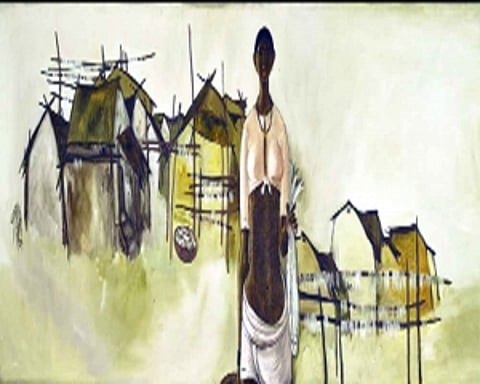
DAG’s offering at the fair, Masterpieces: 100 Years of Indian Art, includes the collection of modern art in one space. Ranging from a portrait of a jewelled dancer from the South to the delicate “wash style” associated with the Bengal School (Kshitindranath Majumdar) to the pathbreaking progressives (K K Ara, M F Husain, Krishen Khanna, S H Raza) and a phenomenal representation of the Madras Art Movement (K Sultan Ali), there are a lot of masterpieces on the display.
Ask Ashish Anand, MD and CEO of DAG, about the current art market? He says, “India’s art market is still young and, therefore, challenging, with a small base, insufficient infrastructure and lack of knowledge about art in general.” While he believes that art has to be accessible and understood by people before a viable market can exist, Jagdip feels that the South Asian art market has undergone a massive transformation since the downturn in 2009.
Through such fairs one can see the Indian art industry evolving at a global level. The international exchange of art and artists is giving a plethora of reasons to the the ones originating in India to leave their imprint. Ashish says, “In the recent years Indian art is making a global presence. Exhibitions and retrospective of Indian artists have opened outside, whether Nasreen Mohamedi and Mrinalini Mukherjee at the Met in New York, Nalini Malani in Paris or Bhupen Khakhar at Tate London, among others.”
Jagdip shares that the galleries are contributing to the development of the cultural scene within the South Asia art industry by laying a foundation for longer-term growth of the Indian art market. “We hear that galleries are making significant sales at all price points to both established and a new, younger generation of collectors, who will be important in shaping the art market of the future. A growth in non-commercial art market initiatives is creating new platforms for discussing, contextualising and promoting contemporary art.”
She believes that over the past decade the region has seen a massive increase in cultural activity with the establishment of new annual and biennial contemporary art initiatives such as the Kochi-Muziris Biennale, the Colombo Art Biennale, the Lahore Biennale, Pune Biennial, the Serendipity Arts Festival and the Dhaka Art Summit. Private patronage for the arts in India and South Asia continues to grow, with increasing support from organisations such as Gujral Foundation and institutions such as Kiran Nadar Museum of Art, Kolkata Centre for Creativity and the forthcoming Museum of Art & Photography, Bangalore. “In conjunction with this, contemporary Indian and South Asian art and artists have been increasingly visible around the globe, generating even greater understanding of the region’s cultural diversity. There have been major exhibitions at the Guggenheim, The Met Breuer as well as high profile partnerships cross-continent between South Asia and Europe, such as the New North and South network which brought together 11 institutions in the UK and South Asia,” she adds.